
1.1
What Is Forex? The Simple Definition
If you are stepping into the financial markets and wondering, “What is forex?” — The simple definition is that it is the global market in which currencies are bought and sold. When you exchange US dollars for euros before a holiday in Europe, you are participating in the forex market. When a Japanese car manufacturer converts its dollar revenues back into yen, or when a central bank intervenes to support its currency, they are doing so in the forex market.
At its most basic level, forex trading means speculating on the relative value of one currency against another. When you believe the euro will strengthen against the US dollar, you buy euros and sell dollars—expressed as buying the EUR/USD currency pair. If you are right and the euro rises, you profit. Conversely, should your prediction be wrong and the currency falls, you lose.
The price of every currency reflects the market’s real-time assessment of that country’s economic health, interest rate outlook, political stability, and inflation trajectory. Understanding what drives these prices—and learning to anticipate their movements—is the essence of forex trading.
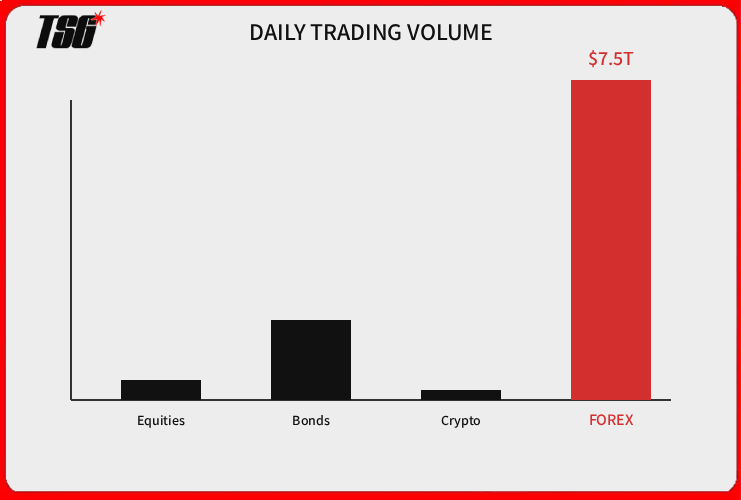
Figure 1 — The forex market dwarfs every other financial market. At $7.5 trillion per day, it processes more volume than global bond, stock, crypto, and commodity markets combined. This extraordinary liquidity is one of forex’s primary advantages for traders.
Currencies as an Asset Class
Unlike stocks (which represent ownership in a company) or bonds (which represent a loan), currencies represent the economic output and policy of entire nations. When you buy the British pound, you are effectively making a bet on the UK economy, the Bank of England’s interest rate policy, and the UK’s political and fiscal stability relative to whatever currency you are selling.
This macro-driven nature makes forex fundamentally different from equity trading. There are no quarterly earnings reports, analyst upgrades, management changes, or product launches. Instead, the drivers are central bank decisions, inflation data, employment reports, GDP growth, and geopolitical events—forces that operate on a global scale and affect entire economies rather than individual companies.
Why Forex Is the World’s Largest Market
The sheer scale of the forex market is not accidental; it reflects the fundamental necessity of currency exchange in the modern global economy. Every time an international trade deal is settled, a multinational corporation repatriates profits, a government stabilizes its exchange rate, or a global fund allocates capital across borders—those transactions flow through the forex market.
The daily volume of $7.5 trillion means that even the largest institutional orders—hedge funds moving hundreds of millions of dollars—are absorbed by the market without the dramatic price impact they would cause in smaller markets. This depth of liquidity is one of forex’s most important practical advantages.
|
1.2
How the Forex Market Works
The forex market has no central exchange—no building, no trading floor, no single location where transactions are processed. Instead, it is a decentralized, over-the-counter (OTC) market: a global network of banks, brokers, electronic platforms, and participants connected electronically, all quoting prices and executing trades simultaneously.
This decentralized structure is why the market never closes. When New York closes, Tokyo opens. When Tokyo closes, London opens. Currency trading moves seamlessly around the globe, creating a continuous 24-hour market that only pauses over the weekend.
The Interbank Market and Retail Access
At the core of the forex market sits the interbank market—a network of the world’s largest banks transacting directly with each other at wholesale prices. Banks like JPMorgan, Citigroup, Deutsche Bank, and HSBC account for a significant portion of all daily volume. They quote prices to each other and large institutional clients, acting as both market makers and speculators.
Until relatively recently, this market was closed to retail traders. Minimum transaction sizes meant only institutions and high-net-worth individuals could participate. The rise of online retail forex brokers changed this fundamentally by aggregating retail orders and routing them to liquidity providers, making the market accessible to anyone with an internet connection.
How a Forex Trade Is Executed
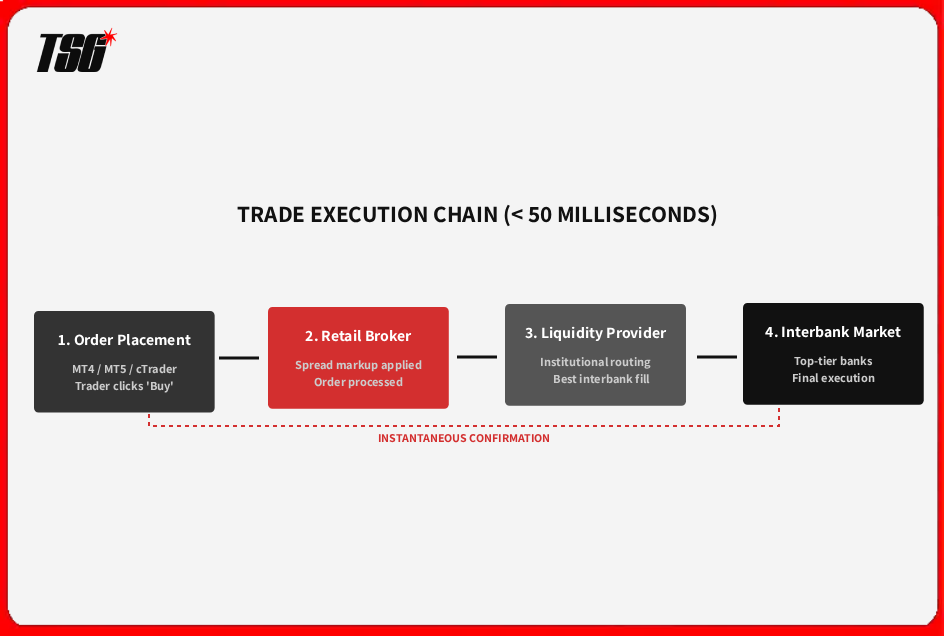
Figure 2 — The execution chain: from your click on MT4/MT5, through your broker, to a liquidity provider, and into the interbank market — all in under 50 milliseconds. The spread you pay is applied at Step 2 by your broker before the order reaches the market.
When you click ‘Buy’ on EUR/USD, the following sequence occurs in milliseconds:
- Step 1 — Order placement: Your platform (MT4, MT5, cTrader) sends your order to your broker’s servers.
- Step 2 — Broker processing: Your broker applies its spread markup to the interbank price and fills the order from its own book (market maker) or routes it to a liquidity provider (ECN/STP).
- Step 3 — Liquidity provision: An institutional liquidity provider fills the order at the best available interbank price.
- Step 4 — Confirmation: Your platform receives confirmation and displays your open position.
This process takes 10–50 milliseconds for major pairs. This speed and transparency are a major advantage of trading the most liquid market in the world.
1.3
Who Participates in the Forex Market?
Understanding who trades forex gives you essential context for interpreting price movements. Not all participants are speculating. Some are managing risk, fulfilling commercial obligations, or implementing monetary policy.
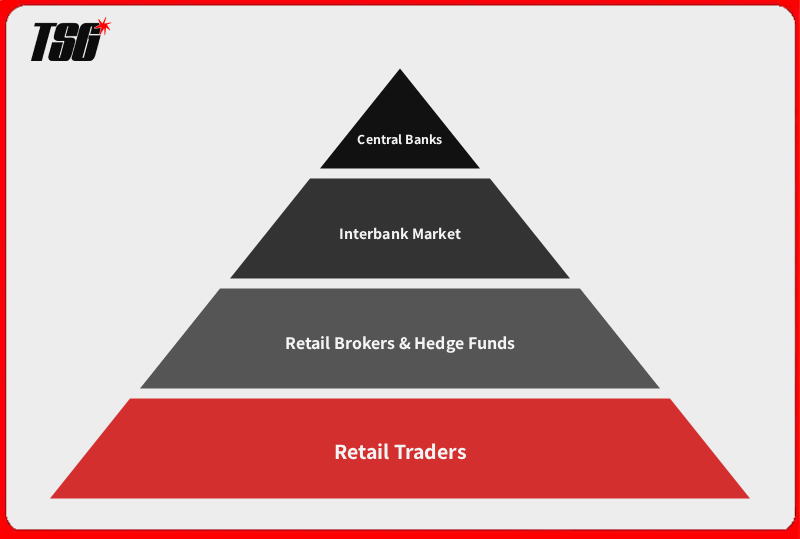
Figure 3 — The forex market hierarchy: from central banks and the interbank market at the top, through institutional traders and retail brokers, down to individual retail traders. Each tier accesses the market through the tier above it, and each adds a small cost markup.
Central Banks, Commercial Banks, and Hedge Funds
- Central banks primarily participate in implementing monetary policy and managing exchange rates. When a central bank raises interest rates, it typically causes its currency to appreciate as international capital flows in. Direct intervention can cause dramatic short-term price movements.
- Commercial banks provide the liquidity that allows everyone else to transact. When a Japanese exporter converts dollar revenues into yen, it transacts through a commercial bank, creating directional pressure independent of speculation.
- Hedge funds and asset managers are the primary sources of institutional speculation. Large institutional flows provide important context—swimming with them is far easier than swimming against them.
Retail Traders: Where You Fit In
Retail traders represent approximately 3–5% of total daily volume. While this sounds small, it represents hundreds of billions of dollars per day. The structural accessibility—micro lot sizes, low minimum deposits, 24-hour access—means the barriers to entry are remarkably low.
You are always trading against someone who knows more than you in aggregate. Your edge must come from superior technical analysis, disciplined risk management, and a clear, rules-based system.
|
1.4
Why Trade Forex? Advantages and Risks
The forex market offers a unique combination of features, but it also carries risks that are frequently downplayed.
24-Hour Market, High Liquidity, Low Costs
| Advantage | What It Means in Practice |
|---|---|
| 24-hour trading | Trade around your schedule — before work, after work, during lunch. No gap risk from overnight exchange closures (except over the weekend). |
| Extreme liquidity | Major pairs like EUR/USD can absorb orders of any size a retail trader will ever place without price impact. Entries and exits are virtually instant. |
| Low transaction costs | Spreads on major pairs are often under 1 pip with ECN brokers during peak hours — far lower than stock commissions on a percentage basis. |
| Easy short selling | Selling a currency pair is exactly as simple as buying it — no borrowing of shares required, no additional fees, no restrictions. |
| Micro lot access | Start with positions as small as 1,000 units — allowing proper risk management even with accounts of $500 or less. |
| High leverage available | Amplify your buying power (with significant risk) to trade larger positions than your account would otherwise allow. |
The Real Risks Beginners Underestimate
The same features that make forex attractive to beginners are also what make it dangerous when misused. The risks below are not theoretical — they are the primary reasons why studies consistently show that the majority of retail forex traders lose money.
- Leverage amplifies losses equally: the same leverage that turns a 1% price move into a 50% account gain also turns it into a 50% account loss. Most beginners focus on the gains and fail to fully internalize the losses until they experience them.
- The 24-hour market creates the temptation to overtrade: with no market close to force you to step away, it is easy to trade excessively — taking low-quality setups out of boredom, holding positions through news events, or revenge trading after losses at 2 am, when your judgment is impaired.
- Currency pairs are driven by macro forces beyond your control: a single central bank announcement can move EUR/USD 200 pips in seconds, stopping out every technical position in its path regardless of how perfect the chart setup appeared.
- Most retail brokers are compensated by your losses: market maker brokers take the other side of your trades. Understanding your broker’s business model is essential to understanding the structural dynamics within which you operate.
|
1.5
Forex vs Stocks: Key Differences
If you are coming to forex from a stock trading background — or trying to decide which market to start with — understanding the structural differences between the two markets is essential. Neither is universally better; they suit different trader profiles, schedules, and analytical approaches.
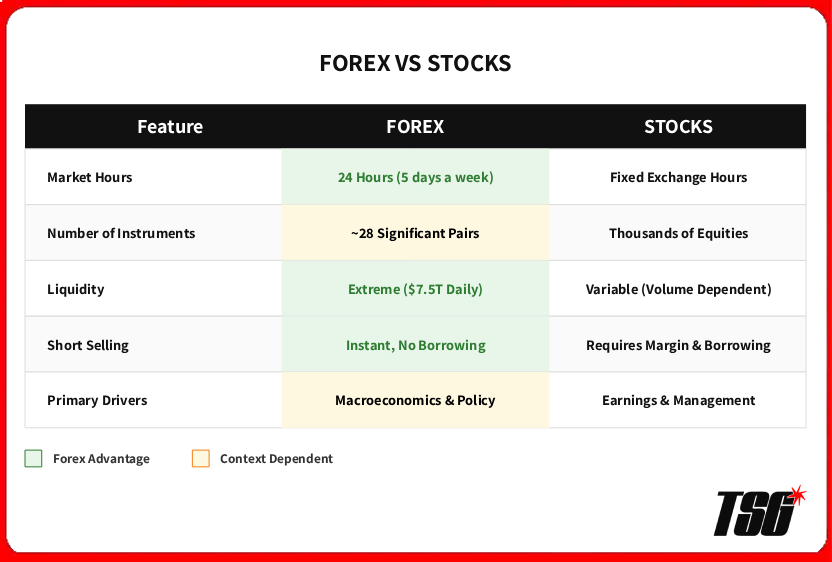
Figure 4 — Forex vs Stocks: a side-by-side comparison of the key structural differences. Green cells indicate a forex advantage; gold indicates context-dependent factors. The best market for any individual depends on their schedule, capital, analytical preference, and risk tolerance.
The two most practically significant differences for beginner traders are:
- Market hours: if you have a day job, the forex market’s 24-hour structure allows you to trade before work, after work, or during the lunch break — flexibility that the stock market’s fixed exchange hours do not offer. The London-New York overlap (13:00–17:00 UTC) provides the best trading conditions and falls during the US working day.
- Number of instruments: the stock market offers thousands of individual equities to analyze — an overwhelming universe for a beginner. Forex offers approximately 28 significant currency pairs, with most professional retail traders focusing on just 3–6 major pairs. This concentrated focus allows beginners to develop deep familiarity with specific instruments rather than spreading their attention too thin.
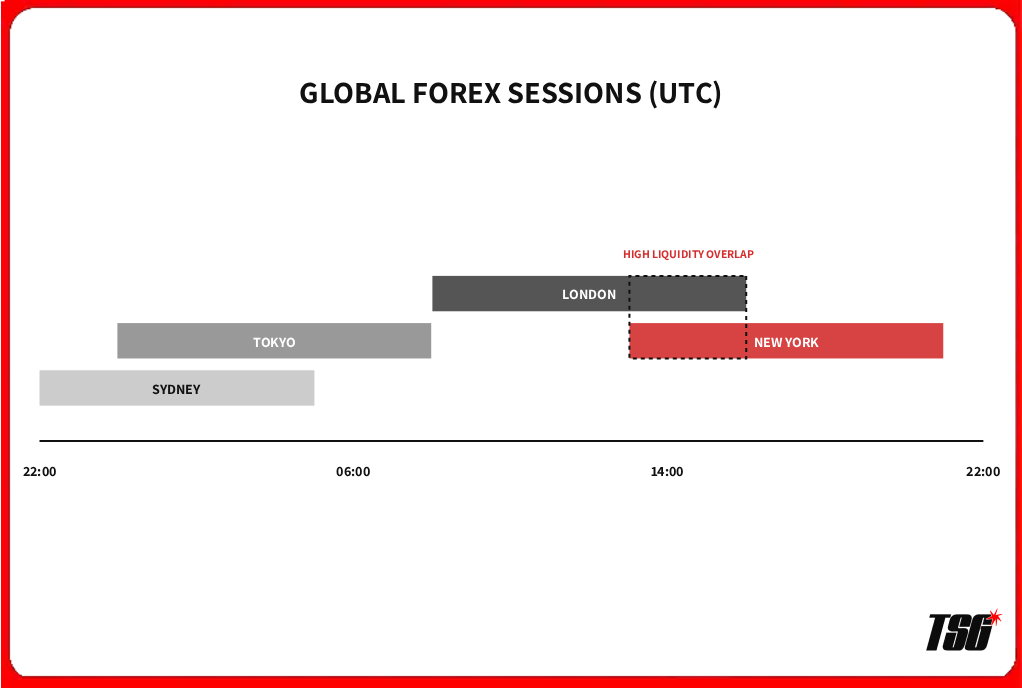
Figure 5 — The 24-hour forex trading day: four overlapping sessions across Sydney, Tokyo, London, and New York. The London-New York overlap (13:00–17:00 UTC) is the most liquid and most traded window of the day, where spreads are tightest, and price moves are most decisive.
1.6
Frequently Asked Questions
Q: How much money do I need to start trading forex?
Technically, you can open a micro account with as little as $100–$200 at many brokers. However, $500–$1,000 is a more practical starting point — enough to trade micro lots with proper 1% risk management ($5–$10 per trade) while having sufficient margin buffer to avoid being stopped out by normal price fluctuation. The most important point: never deposit more than you can afford to lose entirely.
Q: Is forex trading legal?
Yes, but it is regulated differently by jurisdiction (FCA in the UK, CFTC/NFA in the US, ASIC in Australia). Ensure your broker is regulated by a recognized authority.
Q: Can I trade forex part-time while working a full-time job?
Yes — and forex is better suited to part-time trading than most other financial markets precisely because of its 24-hour structure. Swing trading strategies (holding positions for 1–5 days) are particularly well-suited to part-time traders: you analyze charts in the evening, place orders with pre-set stop-loss and take-profit levels, and manage positions without needing to watch screens throughout the day. The London open (08:00 UTC) and the New York close (22:00 UTC) are the two most important daily events for swing traders.
Q: What is the difference between spot forex and forex futures?
Spot forex — the market covered in this course — involves buying and selling currency pairs for immediate delivery at the current exchange rate. It is what retail traders access through MT4/MT5 platforms. Forex futures are standardized contracts to buy or sell a currency at a fixed price on a future date, traded on regulated exchanges like the CME. Spot forex is more accessible, has lower minimum sizes, and is where the majority of retail traders operate. Forex futures are used more by institutional traders for hedging and speculation with defined contract specifications.
Q: How long does it take to become consistently profitable in forex?
Honest answer: typically 1–3 years of serious study and practice for most traders. The learning curve has three distinct phases: understanding the market mechanics (3–6 months), developing and testing a trading system (6–12 months on demo), and managing the psychological challenges of live trading (ongoing). Traders who rush through the first two phases — particularly skipping demo trading — dramatically reduce their chances of reaching consistent profitability. Patience and process are the most underrated qualities in forex trading.
1.7
Quiz
| → Continue Reading
Now that you know what the forex market is, learn the language you need to navigate it: Currency Pairs Explained — Major, Minor and Exotic Pairs. |