Risk Warning: Trading in CFDs, involves a high level of risk. 77.95% of retail investor accounts lose money when trading CFDs with this provider. It is possible to lose all your invested capital. Such financial products may not be suitable or allowed for you, and you should consider such restrictions and whether you understand how CFDs work and all the risks involved.

High-Probability Trading
Marcel Link
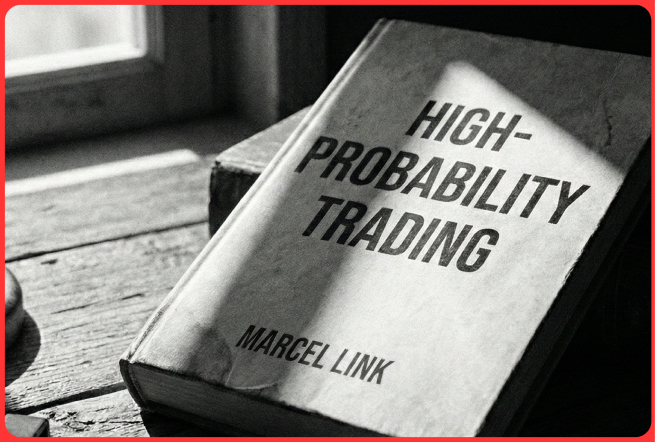
Table of Contents
For many traders, High‑Probability Trading by Marcel Link does not arrive as a trophy on the shelf, but as a last attempt at clarity after a string of losses. It is picked up not by someone who feels like a future Wall Street legend, but by someone staring at a sore pair of eyes, a red account, and a notebook full of messy charts.
Instead of meeting excitement, High‑Probability Trading by Marcel Link. Its first impact is not a promise of quick success, but a sense of recognition: here is an author who admits how brutal the early months can be and treats failure as normal rather than shameful.
How Traders Usually Arrive at High‑Probability Trading
The typical reader of High‑Probability Trading has already tried many systems. They have listened to strangers online, chased setups they barely understood, and crossed their fingers more often than they care to admit. Blame has swung between “the market” and themselves, and the feeling after a bad trade is usually sickness and regret. There is no pride in this stage—only fatigue, money worries, and the quiet thought that maybe keeping a regular job would have been safer.
What Makes Link’s Voice Different
When such a reader opens Link’s book, the tone is striking. He does not hide behind success stories or polished highlight reels. He writes about blown accounts and ignored rules in a way that makes them feel expected, as if nearly every trader’s early journey is supposed to be rough. This honesty can create an immediate sense of trust: Link sounds tired too, and that weariness makes his advice feel real rather than flashy.
How the Reader Begins to Respond
Many readers find themselves marking up the first chapter with private notes. They underline examples and write in the margins, “I did this. I still do.” Sometimes they close the book and sit quietly, feeling both exposed and relieved. The desire to start over grows—to trade as if rules matter, to stop hunting for shortcuts, and to accept that discipline might be more important than excitement.
From this starting point, High‑Probability Trading becomes less a catalog of setups and more a guide to changing how one thinks about trading. The chapters that follow walk through trying and failing, building a routine, accepting probabilities, handling losses, and slowly finding a calmer way to stay in the game.
Trying, Failing, and Learning the Hard Way
At the start of High‑Probability Trading, the focus is not on winning systems but on the messy reality of early failure. The book speaks to traders who have already lost money, broken their own rules, and wondered whether they are cut out for the markets at all. It treats these painful beginnings not as rare exceptions, but as the common starting point.
How High‑Probability Trading Normalizes Losing
Link describes blown accounts, ignored stop‑losses, and emotional decisions as experiences almost every new trader goes through. He shows how repeated losses create doubt, anger, and shame, and how many people hide these feelings rather than learn from them. By openly discussing losing, the book removes some of the isolation and embarrassment that often keep traders stuck.
How Losses Become Feedback Instead of Punishment
High‑Probability Trading urges the reader to treat each loss as information, not as a personal failure. A trading journal full of bad entries is recast as a map of what to avoid, not a list of reasons to quit. The book stresses that the first step toward improvement is to stop seeing losses as proof of being “no good” and start seeing them as specific mistakes that can be studied and reduced over time.
How High-Probability Trading Slows the Trader Down
Link warns against constant action for its own sake—clicking just to feel busy or to win back money after a loss. He argues that many traders do more harm to themselves through overtrading than through any single bad idea. High‑Probability Trading suggests that slowing down, taking fewer trades, and pausing after mistakes are early signs of real progress, even before profitability appears.
Building a Real Trading Routine
After addressing the emotional toll of losing, High‑Probability Trading turns to structure. The book argues that without a routine, no trader can expect consistent results. It shows how a daily process can replace impulsive reactions with deliberate choices and give the trader something stable to lean on when markets feel chaotic.
How High‑Probability Trading Uses Checklists and Written Rules
Link encourages traders to write down clear rules for entries, exits, and risk before the trading day begins. This includes defining setups, position size, and maximum loss per trade. By moving decisions onto paper, the book aims to reduce guesswork in the heat of the moment and make it easier to see when rules are followed or broken.
How the Book Confronts Revenge Trading
High‑Probability Trading highlights “revenge trading” as a common and dangerous behavior. This is the urge to take a new trade quickly after a loss just to recover what was lost. Link treats this reaction as human but destructive, and he pushes traders to recognize it in themselves. The routine he proposes includes deliberate breaks after bad trades, so decisions are made when calm rather than when angry or afraid.
How Journaling Supports the Routine
Link gives special weight to keeping a journal that records not only trades but also emotions before and after each decision. The goal is to see patterns such as fear, boredom, or overconfidence and how they influence behavior. Over time, this written record helps traders adjust both their methods and their mindset, turning the routine into a tool for self‑knowledge and risk control.
Making Peace with Probabilities
With a basic routine in place, High‑Probability Trading tackles a more profound mental shift: accepting that trading is about probabilities, not certainties. The book challenges the natural desire for sure answers and highlights how that desire leads to frustration and overtrading.
How High‑Probability Trading Reframes Expectations
Link explains that even the best setups only offer an edge, not a guarantee. Some good trades will still lose money, and some bad trades will appear to work for a while. High‑Probability Trading teaches that judging a method should be based on many trades, not a handful of outcomes. This shift from “Will this trade win?” to “Does this approach have an edge?” is presented as a key step in maturity.
How the Book Encourages Walking Away
Because probabilities guarantee that losses will occur, the book stresses the importance of stepping aside after a bad run. Link suggests that traders should be willing to stop for the day, or even longer, when emotions are running high. High‑Probability Trading presents walking away not as weakness, but as a disciplined response that protects capital and mental energy.
How Acceptance Reduces Pressure
By insisting that losses are built into any trading career, High‑Probability Trading aims to reduce the pressure to be right all the time. Link wants readers to accept that uncertainty is permanent, and that skill lies in managing risk and behavior, not in predicting every move. This acceptance helps traders stay calmer during drawdowns and less euphoric during winning streaks.
When Losing Becomes Familiar
High‑Probability Trading also examines what happens when losing is no longer a surprise but a recurring part of daily life. It explores the loneliness, self‑doubt, and identity questions that can appear when a trader has been struggling for a long time.
How the Book Describes the Emotional Weight of Losses
Link acknowledges that some losses hurt far beyond their dollar size. They can make traders question their intelligence, their future, and their decision to trade at all. High‑Probability Trading talks about evenings filled with regret, silence, and the urge to walk away from screens forever. Naming this experience is meant to help traders see that they are not alone or uniquely broken.
How Small, Quiet Wins Begin to Matter
Against this dark background, the book points to small, almost invisible signs of improvement. High‑Probability Trading notes that days with fewer mistakes, correctly followed stops, or trades skipped because they did not fit the plan are real wins, even if the profit is small or negative. By drawing attention to these quiet gains, Link helps traders rebuild confidence in behavior rather than in occasional big wins.
How High‑Probability Trading Redefines a “Good Day”
Over time, the book suggests that a good trading day is not defined only by profit, but by how well rules were followed and how calmly setbacks were handled. High‑Probability Trading encourages traders to see progress in surviving without drama, logging trades honestly, and ending the day with enough emotional energy to return tomorrow. This redefinition helps soften the impact of familiar losses.
Learning Patience in a World That Never Waits
Once the trader begins to accept losses and see small behavioral wins, High‑Probability Trading turns to patience. The book argues that waiting is one of the most complex skills to learn, especially in a world where screens, news, and other traders constantly urge action.
How High‑Probability Trading Teaches Not Trading as a Decision
Link repeats that most days offer few truly high‑probability setups. He urges traders to accept that doing nothing can be the best choice when conditions or patterns are not right. High‑Probability Trading frames “no trade” as an active decision that protects the account, not as a failure to act.
How the Book Addresses FOMO and Comparison
The book also deals with fear of missing out, especially when others seem to be trading and posting big wins. Link warns that chasing someone else’s pace or style often leads to bad entries and emotional exits. High‑Probability Trading advises traders to stick to their own plan and time frame, reminding them that the market will always offer new opportunities.
How Patience Becomes an Edge
High‑Probability Trading emphasizes patience as an invisible advantage that does not appear on any indicator. By waiting for setups that truly match the rules, avoiding forced trades, and accepting quiet days, traders reduce unnecessary losses. Over many months, this restraint can become a significant edge, even though it rarely feels exciting or earns praise.
Finding Joy in Small Wins
After patience, High‑Probability Trading turns to a quieter kind of reward: the small, almost invisible wins that come from self‑control. The book shows how these gains often matter more for long‑term success than rare, dramatic profits.
How High‑Probability Trading Redefines “Winning”
Link challenges the idea that joy in trading must come from big, memorable trades. He points instead to moments when a trader follows a stop, reduces size after a tough day, or refuses a tempting but rule‑breaking setup. High‑Probability Trading suggests that these private decisions build confidence, even if no one else notices.
How Private Discipline Becomes a Source of Pride
The book encourages traders to record and value these small victories in their journals. Notes such as “followed the plan,” “did not chase,” or “stayed calm in a fake breakout” become evidence of progress. Over time, High‑Probability Trading teaches that pride can come from quiet discipline rather than from spectacular outcomes, making trading feel more stable and less like a constant test.
Trading’s Shadow Outside the Screen
High‑Probability Trading also explores how trading spills into the rest of life. Link recognizes that the stress of gains and losses does not remain confined to the monitor. It affects mood, relationships, and daily habits.
How High‑Probability Trading Shows the Cost of Obsession
The book describes how long losing streaks can lead to irritability, withdrawal from friends and family, and a constant replaying of trades in the mind. Link warns that when every conversation and thought revolves around the market, balance is lost. High‑Probability Trading urges traders to notice these patterns and to take them as signs that boundaries are needed.
How Trading Habits Can Improve Life Beyond Markets
At the same time, Link points out that the discipline learned in trading can help elsewhere. The same pause used before entering a position can be used before reacting in daily situations. High‑Probability Trading suggests that routines, journaling, and patience can make a person less impulsive in general, turning trading lessons into life skills rather than isolated rules.
Living with Doubt and the Power of Boredom
Even with better habits, doubt remains a steady companion. High‑Probability Trading does not try to erase this uncertainty. Instead, it shows how to live with it, and how boredom—often seen as a problem—can become a protective force.
How High‑Probability Trading Normalizes Doubt
Link explains that wondering “Am I good enough for this?” is common and often healthy. He warns that forced confidence can be more dangerous than honest uncertainty. High‑Probability Trading encourages traders to admit doubt in their journals and to keep following their rules, even when they doubt, letting real confidence grow slowly from repeated, calm behavior.
How Boredom Becomes a Hidden Advantage
The book reframes boredom as a sign that a trader is not forcing trades. Long stretches of quiet, when no valid setup appears, are presented as a natural part of a high‑probability approach. High‑Probability Trading teaches that learning to sit through these periods without creating action for its own sake can prevent many unnecessary losses and preserve mental energy.
Handling Big Losses and Starting Fresh
High‑Probability Trading does not pretend that all losses will be small. Some will be large and painful, leaving a lasting mark. Link confronts these events directly and explains how to recover both financially and emotionally.
How High‑Probability Trading Approaches Major Losses
Link notes that big losses often come from a chain of smaller decisions: ignored stops, oversized positions, or trading while upset. He advises traders to analyze these episodes in detail, not to punish themselves but to understand the sequence that led to them. High‑Probability Trading insists that a clear, written reflection after a significant loss is essential to prevent the same pattern from repeating.
How the Book Frames Repeated Fresh Starts
The book also stresses that “starting fresh” is not a one‑time event. Traders may need to reset their approach many times—taking breaks, reducing size, rewriting rules, and returning with a simpler plan. High‑Probability Trading presents these resets as a regular part of a trading career, not as proof of failure. Each honest restart is seen as a step forward in itself.
Rediscovering Enjoyment and Balancing Life
Toward the end, High‑Probability Trading returns to a central question: why keep trading at all? After the losses, routines, and resets, the book suggests a different form of enjoyment and a healthier balance between trading and the rest of life.
How High‑Probability Trading Redefines Enjoyment
Link moves away from excitement as the main source of satisfaction. He describes enjoyment as the feeling of working a plan, logging trades carefully, and ending the day without chaos. High‑Probability Trading suggests that steady, undramatic days—without big wins or disasters—can be deeply satisfying once a trader stops chasing constant thrills.
How the Book Encourages Boundaries and Long‑Term Perspective
Finally, the book urges traders to set limits on trading time and attention, allowing space for relationships, health, and other interests. High‑Probability Trading ties this balance to a long‑term view: thinking in years instead of days, judging progress by habits rather than single trades. In this way, trading becomes part of a broader life, and staying in the game—calm, honest, and patient—counts as a lasting success.
The Trading Plan and Game Plan
Beyond mindset and emotions, High‑Probability Trading stresses that no trader can succeed without a clear written plan. The book treats planning as the bridge between good intentions and repeatable behavior. A trading plan and a daily game plan together define what to trade, when to trade, and how much to risk.
Instead of leaving decisions to the heat of the moment, Link wants the trader to do most of the thinking when markets are closed and emotions are calm. The plan becomes a personal rulebook, and the game plan becomes a script for each day. Together, they turn trading from an improvisational process into a structured one.
How High‑Probability Trading Defines the Trading Plan
High‑Probability Trading describes the trading plan as a complete outline of the trader’s business. It includes which markets to trade, what time frames to use, what setups qualify as trades, how much to risk per position, and what maximum drawdowns are acceptable. The plan also covers practical matters such as starting capital, tools, data sources, and trading hours.
Link insists that the plan be written and specific, not vague ideas held in memory. By putting rules on paper, the trader gains a standard against which to measure behavior. High‑Probability Trading emphasizes that a plan does not guarantee success, but the lack of one almost guarantees confusion and inconsistency.
How the Game Plan Guides Each Day
Alongside the overall trading plan, High‑Probability Trading introduces a daily game plan. This is a short, focused document prepared before the market opens. It lists key levels, possible scenarios, planned setups, and any special conditions for that session. The game plan translates the broad rules of the trading plan into concrete intentions for the day.
Link encourages traders to review overnight news, study charts, and note likely areas of support and resistance before placing a single order. High‑Probability Trading teaches that this preparation reduces surprise and helps traders recognize when the market is behaving as expected—or when it is better to stand aside. The game plan is flexible, but it provides a starting point that keeps the trader from drifting.
How Planning Supports Discipline and Review
High‑Probability Trading links planning directly to discipline and long‑term improvement. When trades are entered and exited according to a written plan, they can be reviewed objectively. The trader can ask whether losses came from a flawed method or from breaking rules. Without a plan, every mistake looks unique, and patterns remain hidden.
Link also notes that a good plan evolves over time. As journals and statistics accumulate, the trader can refine setups, adjust risk limits, or drop unproductive strategies. High‑Probability Trading presents this cycle—plan, act, review, adjust—as the core of professional growth, turning planning into a living process rather than a one‑time task.
High‑Probability Trade Setups
High‑Probability Trading makes clear that not every price move is worth trading. The book focuses on identifying situations where the odds lean enough in the trader’s favor to justify risk. These are the “high‑probability” setups that give the book its name.
Rather than promising a single secret pattern, Link shows how to think about context, structure, and confirmation. High‑Probability Trading teaches that good setups emerge when several favorable factors line up, not from one isolated signal.
How High‑Probability Trading Uses Market Context
Link starts by stressing the importance of the market environment—trends, volatility, and key levels. He encourages traders to identify whether a market is trending, ranging, or reversing before looking for entries. A trend‑following setup in a choppy range, or a mean‑reversion setup in a strong trend, is less likely to succeed, even if the pattern looks appealing.
High‑Probability Trading emphasizes support and resistance zones, previous highs and lows, and areas of heavy volume as essential reference points. Trades taken near these levels, in line with the broader context, often have more precise definitions of risk and reward than trades taken in the middle of nowhere on the chart.
How the Book Combines Signals for Better Odds
The book argues that a single indicator or candlestick rarely creates a strong edge on its own. Instead, Link favors combinations: for example, a pullback to support within a trend, confirmed by volume, and aligned with the trader’s time frame. High‑Probability Trading suggests that when several independent factors point in the same direction, the probability of success improves.
Link discusses tools such as moving averages, oscillators, and chart patterns, but always within a larger framework. He warns against adding indicators endlessly and urges traders to choose a small, well‑understood set. High‑Probability Trading promotes depth of understanding over complexity, arguing that too many signals can create confusion rather than clarity.
How Setups Are Turned into Written Criteria
High‑Probability Trading encourages traders to turn each favored setup into a clear list of conditions. These criteria might include trend direction, acceptable indicator ranges, distance to support or resistance, and invalidation rules. By writing these conditions down, the trader turns vague ideas like “it looks good” into specific, testable rules.
Link notes that this structure makes it easier to avoid marginal trades that only half‑fit the plan. High‑Probability Trading suggests that consistency comes from taking trades that meet the complete checklist and passing on those that do not, even when they are emotionally tempting. This disciplined selection is part of what makes a setup truly high probability.
Entries, Exits, and Risk‑Reward
Beyond identifying setups, High‑Probability Trading devotes significant attention to how traders enter and exit positions. Link argues that good analysis can be ruined by poor execution, and that entries, exits, and risk management must be planned as carefully as the setups themselves.
The book frames each trade as a complete package: where to get in, where to get out if wrong, where to take profits if right, and how much is at risk. High‑Probability Trading insists that these elements be decided before the order is placed, not improvised afterward.
How High‑Probability Trading Structures Entries
Link explains that entries should be based on clear triggers derived from the setup criteria. This might involve price breaking above or below a certain level, a pattern completing, or a signal from a chosen indicator. High‑Probability Trading emphasizes that waiting for the full trigger reduces premature entries based on anticipation or fear of missing out.
The book also discusses the timing of entries within the trading day. Link notes that some markets behave differently at the open, midday, and close, and encourages traders to learn these rhythms. High‑Probability Trading suggests focusing on entries when liquidity and volatility suit the strategy, rather than taking trades at random times.
How the Book Handles Stops and Profit Targets
High‑Probability Trading treats stop‑loss orders as non‑negotiable tools for survival. Link recommends placing stops at logical points where the original reason for the trade is clearly invalidated, such as beyond support or resistance, rather than at arbitrary distances. He stresses that moving stops farther away to avoid being hit usually leads to larger, more painful losses.
For profit targets, the book suggests aiming for rewards that are meaningfully larger than the risk taken. High‑Probability Trading often refers to risk‑to‑reward ratios, such as risking one unit to make two or more. Link explains that even with a modest win rate, favorable risk‑reward can make a strategy viable, while poor risk‑reward can make frequent winners unprofitable over time.
How Risk‑Reward Shapes Trade Selection
High‑Probability Trading encourages traders to consider risk‑reward before entering any trade. If the potential gain is too small relative to the necessary stop, the book suggests passing on the opportunity, even if the setup looks technically sound. This filter helps concentrate capital on situations where the math supports long‑term success.
Link also ties position sizing directly to risk per trade. He advises defining a fixed percentage or amount of capital that can be lost on each trade, then adjusting the number of shares or contracts accordingly. High‑Probability Trading presents this as a key defense against emotional swings and catastrophic losses.
Reviewing, Managing, and Avoiding Overtrading
In its later sections, High‑Probability Trading returns to the theme of ongoing management. The book stresses that how traders review their work and control their activity level matters as much as their setups. Overtrading—taking too many trades or trading without an edge—is treated as one of the main threats to consistent performance.
Link presents review and restraint as twin tools for long‑term survival. High‑Probability Trading shows that disciplined traders do not just work during market hours; they also analyze, adjust, and sometimes deliberately stand aside.
How High‑Probability Trading Uses End‑of‑Day Review
The book recommends a regular review process “after the close.” Traders are urged to print or save their trade charts, mark entries and exits, and write notes on what went according to plan and what did not. High‑Probability Trading suggests looking for repeated mistakes, such as entering too early, ignoring stops, or trading outside defined setups.
Link explains that this review is not about self‑blame, but about pattern recognition. Over weeks and months, the trader can see which setups perform best, which times of day are most profitable, and which habits cause trouble. High‑Probability Trading presents this feedback loop as essential for refining the trading plan and improving discipline.
How the Book Identifies and Limits Overtrading
High‑Probability Trading defines overtrading as taking more trades than the plan allows, trading out of boredom, or risking too much in search of quick recovery. Link lists signs such as jumping into marginal setups, increasing size after losses, and feeling unable to step away from the screen. He warns that overtrading often leads to rapid drawdowns and emotional burnout.
To counter this, the book advocates clear limits: a maximum number of trades per day, a maximum loss per day, and rules for stopping after a sequence of losing trades. High‑Probability Trading also encourages non‑trading activities—walks, breaks, and time away from screens—to reset the mind. These measures help keep trading aligned with high‑probability opportunities rather than emotional impulses.
How Management Ties the Whole Approach Together
In its management chapters, High‑Probability Trading brings together planning, execution, psychology, and review into one cycle. Link shows that a trader who plans carefully, trades only valid setups, manages risk, reviews results, and limits activity is much more likely to survive the inevitable ups and downs of markets.
The book closes by suggesting that success in trading is less about finding a perfect system than about following an imperfect yet sound method consistently. High‑Probability Trading leaves the reader with a simple message: high probability comes not from eliminating uncertainty, but from aligning rules, habits, and expectations with the realities of the market over many years.
Closing Thoughts: Surviving the Markets the High‑Probability Way
High‑Probability Trading does not promise a glamorous life or a flawless system. It offers something quieter and more durable: a way to stay in the game without being destroyed by it. Across its chapters, the book keeps returning to the same core: routine, probabilities, and emotional honesty.
Instead of trying to remove uncertainty, Link shows how to live with it. He asks traders to accept that losses, doubt, and boredom are not signs of failure but parts of the landscape. The goal is not to win every day, but to keep trading without losing control of money, mind, or life.
What Really Matters in High‑Probability Trading
The book’s focus rests on a few simple practices done well: a written trading plan, a daily game plan, carefully chosen setups, clear entries and exits, and steady review. Around this structure, Link places patience, restraint, and self‑awareness as the traits that turn a method into a real edge.
High‑Probability Trading urges traders to judge themselves less by occasional big wins and more by repeated, quiet decisions: following stops, skipping bad trades, limiting size, and stepping away when emotions run high. Over time, these choices shape both performance and character.
The Kind of Trader This Book Tries to Build
In the end, High‑Probability Trading is not about creating market legends. It is about helping traders become reliable, steady participants who can last for years instead of months. Link’s vision of success is modest but powerful: a trader who plans, waits, manages risk, reviews honestly, and keeps trading without burning out.
For readers who recognize themselves in the early pages—tired, doubting, but still hopeful—the book offers a path that values survival over spectacle. High probability, in this sense, means aligning rules, habits, and expectations with how markets truly work, and letting that alignment quietly compound over time.