Risk Warning: Trading in CFDs, involves a high level of risk. 77.95% of retail investor accounts lose money when trading CFDs with this provider. It is possible to lose all your invested capital. Such financial products may not be suitable or allowed for you, and you should consider such restrictions and whether you understand how CFDs work and all the risks involved.

Algo Trading Cheat Codes
Kevin J. Davey
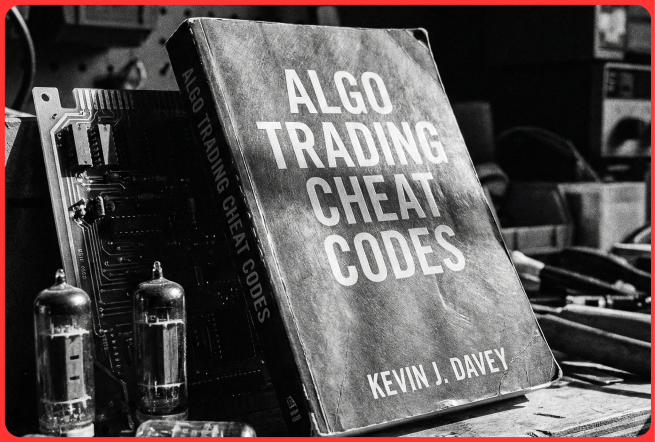
Table of Contents
In Algo Trading Cheat Codes, Davey shares everything. Across 57 battle-tested cheat codes, he reveals the strategies that pushed him to the top. He covers technical methods and crucial human decisions: when to enter, how to exit, and how to stay composed amid chaos. These insights come from years of real-world combat in stocks and commodities, where every mistake costs money and confidence. Every trick, chart, and pattern flows from his obsession with finding order in disorder. This book isn’t a beginner’s manual—it’s a survival guide for serious traders.
You won’t find empty promises here. Instead, the book poses a challenging question that every trader faces: Will you use these cheat codes to beat the market, or will the market swallow you whole, smiling?
Is Algo Trading Getting Harder?
A trader hunches over the screen, caught in a sea of flashing charts that never pause. Algorithms act before the trader even reacts. Kevin J. Davey opens with this stark image: the trader freezes, already outpaced by machines.
Then Davey asks a tricky question: Has the market really become harder, or are we just failing to understand it? Drawing on the precision of an aerospace engineer and the scars of a seasoned trader, he argues that the market’s complexity doesn’t scare newcomers. Instead, lack of structure, illusions of quick success, and blind faith in untested ideas do.
He paints vivid examples—like traders dreaming of making a fortune from a beach while their capital quietly vanishes. This industry is constantly evolving, and strategies have shorter lifespans. Common mistakes include overfitting, ignoring slippage, and skipping validation. Davey champions a disciplined, consistent approach. He supports this with solid data from futures like the ES, which shows performance decay rates. Only traders who continually strive for improvement will survive. In this dog-eat-dog environment, innovation without discipline becomes a trap. So here’s the harsh question: Are you building your path on solid ground, or is your algorithm—no matter how brilliant—already starting to wobble?
Full-Time Algo Trading
Leaving the stability of a traditional job for the uncertainty of markets isn’t impulsive, and Davey knows this well. In Chapter 2, he explores how to transition to full-time algorithmic trading. It’s not a leap of faith but a calculated shift.
Drawing from his experience, Davey shares an uncomfortable truth: without a solid, verifiable track record, freedom is just a fantasy. Platforms like Zulu for forex or Striker for futures help traders validate performance. They strip trading of hollow promises. He details the grueling process of building a public track record—a non-negotiable resume for any aspiring professional.
He also offers alternative paths. For example, managing a $1 million portfolio with a 20% annual return yields approximately $60,000 per year after accounting for exchange fees, data feeds, and software costs—a figure that may be less glamorous than many imagine.
The real challenge lies in the bet itself. Trading independently grants autonomy, yes. However, it also requires unwavering discipline, substantial capital, and the emotional resilience to navigate volatility without a safety net. Through real-life examples—such as a trader who built a track record at a small firm before advancing—Davey proves that there are no shortcuts. Becoming a professional trader isn’t a dream; it’s a daily battle between conviction and chaos.
15 Algo Trading Tips
Developing an algorithmic strategy isn’t just writing elegant formulas—it’s a minefield where one wrong line of code can undo months of work. In Chapter 3, Davey stresses this clearly: coding without validation is like trading blindfolded.
Drawing from his experience in markets like CL and ES, he reveals common dangers. Overfitting, false confidence from excessive optimization, and skipping out-of-sample testing all undermine success. He provides a stark checklist: always forward-test, use walk-forward analysis, and never trust a strategy that hasn’t been tortured through every conceivable market regime.
For Davey, finding a good entry point isn’t enough. Exits, such as stop-and-reverse strategies, often prove more decisive. A good entry gets you in the game, but a great exit locks in the money.
However, technique alone won’t hold a strategy together—the human factor is also crucial. Mental discipline, impulse control, and sticking to the system amid market noise carry unexpected weight. The real challenge isn’t inventing brilliance. It’s resisting the urge to trust your system unquestioningly. Between creativity and rigorous validation lies a perilous gap. Only those who navigate this edge with care stand a real chance of success.
Bar Size Study
Algorithmic traders don’t always rely on complex models. Sometimes, simple details like bar size can decide success. In Chapter 4, Davey, a seasoned trader and World Trading Champion, examines how bar size impacts algorithmic trading. He tests trend-following and counter-trend strategies across 40 futures markets, including ES and GC, from 2006 to 2021.
His study, illustrated in charts such as “Profit vs. Bar Size,” reveals a harsh truth: even before accounting for costs, smaller bars (under 10 minutes) consistently underperform. Daily bars consistently stand out as robust. When traders factor in fees, small bars quickly lead to heavy losses. Charts such as “Max Drawdown vs. Bar Size” show daily bars as safer, with shallower equity curve drawdowns, although markets like HO and RB break this trend, favoring shorter intervals.
Davey stresses that slippage and commissions can destroy short-bar strategies. He urges traders to manage costs carefully and to question the allure of speed. The core conflict lies in striking a balance between the frequency of trade and financial sustainability. Chasing rapid trades often leads straight to ruin. Will traders heed Davey’s advice to favor sturdy daily bars, or will fleeting intraday chances lure them away?
Mean Reversion Study
Mean reversion offers a tempting promise: the market strays but always returns—at least, that’s the belief. In Chapter 5, Davey, a master of algorithmic strategy, examines mean reversion techniques to capitalize on these price swings. He tests seven approaches, including short-term Connors RSI and Reverse Breakout, across several futures markets.
Using strategies such as Bollinger Band Stretch and Moving Averages, Davey’s TradeStation experiments demonstrate that strategies 2, 3, 4, 6, and 7 perform the best. They shine especially when combined using “AND” logic, as in “Top Combinations: AND Configuration,” creating a robust synergy that filters out weak signals.
By contrast, “OR” setups and timed exits after seven bars weaken performance. Ags and softs also underperform compared to interest rate and energy markets, revealing the strategy’s dependency on asset classes.
Davey stresses the importance of rigorous testing. He warns that mean reversion’s true strength lies in stacking techniques, but this comes with a trade-off. Too few trades can render results statistically unreliable, turning a good idea into a lucky sample. The core conflict is apparent: combining strategies boosts returns but requires precision to avoid overfitting. As Davey reveals these insights, traders must ask themselves: can they ride mean reversion’s rhythm to outsmart the market, or will its wild swings sweep them away?
Risk Protection Techniques
Protecting capital in volatile futures markets is not just wise—it’s essential. In Chapter 6, Davey, a disciplined algorithmic trader, tests risk-protection methods using a pullback strategy on 120-minute crude oil bars.
His experiments, as shown in charts like “Daily Loss Limit (Optimal Value = $2,500),” demonstrate that setting a daily loss limit at $2,500 yields improved results by cutting off catastrophic losing streaks. In contrast, an on/off switch that stops trading during extreme swings yields mixed outcomes, sometimes saving capital but often missing significant recoveries.
Davey points out that delaying trades after losses or closing positions before weekends often reduces profits, as seen in “Impact of No Weekends,” where avoiding gaps also means avoiding gap wins.
The core conflict is striking a balance between safety and opportunity. Overly cautious measures can choke gains and suffocate a strategy’s profitability. Drawing on his championship experience, Davey advises traders to test their risk controls rigorously. He warns strongly against relying on untested assumptions, as what feels safe might be the riskiest move of all. As he explains these safeguards, Davey challenges traders: Will you strengthen your systems with his proven methods, or will market volatility erode them?
Bull/Bear Regime Trading
Reading the market is like entering a party without knowing if the mood is upbeat or somber. Success depends on recognizing the tone quickly. In Chapter 7, Davey—drawing inspiration from the difference between his style and his wife Amy’s party planning flair—explores bull/bear regime trading. This method helps traders identify and master distinct market phases.
He tests 40 futures markets like AD and CL, using momentum and Bollinger Bands strategies. Davey applies filters to spot bullish, bearish, or flat regimes, as shown in “Trades With and Without Regime Filter.” He finds that momentum filters with 100–200 bar lookbacks improve net profit and reduce drawdowns by ensuring the strategy only trades with the prevailing market wind.
By contrast, long-period RSI filters underperform. ADX filters reduce trade frequency to unreliable levels, creating a strategy that is too cautious to be profitable.
Davey stresses simplicity to avoid curve fitting. He also notes that volume and volatility filters further enhance performance, as seen in “Combinations of 4 Momentum Filters,” creating a multi-layered regime detection system. The key conflict is striking a balance between selectivity and opportunity. Too strict filters may cause traders to miss valuable trades and starve their strategy of opportunities. The question remains: will traders utilize Davey’s regime-based cheat codes to sync with the market rhythm, or will they falter amid its unpredictable swings?
Exit Testing
Entries may catch the eye, but exits decide a strategy’s success. In Chapter 8, Kevin J. Davey focuses on a vital yet often overlooked aspect of algorithmic trading: when and how to exit trades.
He utilizes over a decade of data from markets like ES and GC and spends more than 100 hours testing 15 exit types. These range from classic stop-and-reverse to complex Yo-Yo stops. His results, shown in charts like “Best and Worst Exit Types,” reveal a clear truth: simplicity wins. Stop & Reverse performs best, followed by breakeven stops. Traders can identify technical exits using indicators like the RSI lag, as shown in “Using Technical Indicators as Exits,” but these often add complexity without adding value.
Davey points out that many traders fixate on perfecting entries, but actual skill—and profit—comes from good exits. His tests show energy and equity markets favor simple exit systems. Complex exits, despite seeming clever, often underperform, as they can choke the strategy with unnecessary rules.
The dilemma is apparent: between the power of simplicity and the lure of complexity, many traders pick the more challenging route. Davey challenges readers with this question: Will traders learn to embrace the principle that less is more in exits, or will they stay trapped in noisy, ineffective systems?
Reward To Risk Study
For years, traders have adhered to the 3:1 reward-to-risk ratio as a key principle. In Chapter 9, Kevin J. Davey tests this rule with complex data, not assumptions.
He runs over 980,000 simulations across markets such as ES, GC, TY, CT, and EC, spanning a ten-year period. He studies many combinations of profit targets and stop-losses measured in ATR units. The results, shown in charts like “Reward/Risk Results, ES,” break tradition: small profit targets (1.0 ATR) paired with wide stop losses (7.0 ATR) deliver surprisingly high win rates, including 89.4% in the ES, turning conventional wisdom on its head.
Some markets, such as soybeans and crude oil, tend to prefer traditional setups with larger profit targets, proving that no single rule fits all. But the general trend is evident across most assets. What looks risky may bring more consistency. Davey warns against trusting untested rules. He reminds traders that inherited beliefs can become dangerous traps in a changing market.
The core conflict runs deep: high win rates demand accepting bigger losses and tighter emotional margins, testing a trader’s resolve on every single trade. The numbers don’t lie. Davey challenges modern traders: Will they cling to comforting old formulas or rethink risk management with fresh eyes?
Profitable Closes Study
Exiting at the right moment can make or break a trade. In Chapter 10, Kevin J. Davey explores closing positions after a set number of winning or losing bars. He uses random entries to isolate the effect of the exit.
He analyzes over ten years of data from markets such as ES, gold, TY, CT, EC, soybeans, and crude oil. His results, shown in charts like “Mini S&P – NProf/NLoss Results,” reveal surprising patterns. In most markets, the best results come from exiting after a few winning closes (such as 2 in ES) and allowing more losing closes (such as 9), demonstrating the power of letting winners run and cutting losses quickly.
But exceptions exist. Gold, soybeans, and crude oil tend to prefer longer winning streaks and shorter loss tolerances. Crude oil achieves a 70% win rate using NProf = 10 and NLoss = 1, as shown in “Crude Oil – NProf/NLoss Results,” revealing its strong trending nature.
Davey insists there is no one-size-fits-all rule. Each market has its own unique rhythm and personality. Forcing a generic strategy often fails. Backed by systematic TradeStation testing, he asks a key question: Will traders customize their systems to fit each asset’s character, or will they keep chasing generic formulas in a world that demands precision?
Closing Thoughts
At the journey’s end, a trader faces an expanding digital frontier. Armed with algorithms, they confront a merciless market. In Algo Trading Cheat Codes, Kevin J. Davey—a World Trading Champion—distills years of real experience into clear, practical principles. He brings order to chaos through data.
From carefully building strategies in Chapter 1 to making precise exits in Chapter 10, Davey breaks myths, confirms ideas, and sharpens decision-making. Whether refining bar size, applying mean reversion techniques, or adjusting risk controls like the Daily Loss Limiter, Davey demonstrates that structured simplicity—not complexity—drives consistent results.
His research in markets like ES and crude oil reveals that simple strategies, such as Stop & Reverse exits and unconventional reward-to-risk ratios, can outperform traditional models. Yet the challenge remains: between innovation and excess, intuition and validation, the modern trader must make a decision.
Supported by thousands of tests, Davey offers no guarantees—only maps. The choice is yours: Will you use these cheat codes to outsmart the market’s harsh logic or stay trapped in unproven systems? The invitation is clear: test, refine, endure, and advance.