
5.1
Supporting Concepts: The Foundations of Forex Trading
Before examining the forex market sessions in detail, new traders benefit from understanding four foundational ideas. Indeed, these concepts appear constantly throughout any serious trading program.
What Is a Forex Market?
Fundamentally, the forex market (foreign exchange market) is the global marketplace for buying and selling currencies. Furthermore, it is the world’s largest financial market. Over $7.5 trillion changes hands every single trading day. However, no central exchange exists. Instead, banks, institutions, governments, and retail traders transact directly through a global network of electronic connections.
Additionally, currencies always trade in pairs — for example, EUR/USD. Specifically, when you buy EUR/USD, you buy euros and simultaneously sell US dollars. Ultimately, the forex market exists because cross-border trade, investment, and travel all require currency conversion. This constant commercial demand keeps the market active nearly every hour of the week.
How Do Currency Pairs Work?
Essentially, a currency pair shows the price of one currency expressed in another. In this arrangement, the first currency is the base currency, while the second is the quote currency. For instance, if EUR/USD trades at 1.0850, one euro costs 1.0850 US dollars.
- Typically, major pairs include EUR/USD, GBP/USD, USD/JPY, and USD/CHF. Because of their volume, they carry the highest liquidity and lowest spreads.
- On the other hand, cross pairs (or minors) pair two non-USD currencies — for example, EUR/GBP or AUD/JPY. Naturally, they are highly active during their home sessions.
- Finally, exotic pairs include one major and one emerging-market currency. As a result, they carry wide spreads and lower liquidity.
What Are Pips?
Fundamentally, a pip (percentage in point) is the smallest standard price movement in a currency pair. Generally, for most pairs, one pip equals a movement of 0.0001 in the exchange rate. However, for pairs involving the Japanese yen (JPY), one pip equals 0.01.
Crucially, PIP value determines your profit or loss per trade. To illustrate, for a standard lot (100,000 units), one pip in EUR/USD equals approximately $10. Therefore, understanding pip value is essential before applying any leverage.
Leverage and Margin
Broadly speaking, leverage allows traders to control large positions with a smaller capital deposit. For example, a leverage ratio of 100:1 means $1,000 controls a $100,000 position. Importantly, leverage amplifies both gains and losses equally — thus, it is not a free advantage.
Meanwhile, margin is the deposit your broker requires to open a leveraged position. Consequently, if the margin falls below the required level, the broker issues a margin call and may automatically close your positions. To mitigate this risk, most regulated brokers cap retail leverage at 30:1 or lower to protect beginners from outsized losses.
Forex Fundamentals: Key Terminology at a Glance
| Term | Definition | Example |
|---|---|---|
| Forex Market | Global decentralized marketplace for currency exchange | $7.5 trillion/day average turnover |
| Currency Pair | Price of one currency expressed in another | EUR/USD = 1.0850 |
| Pip | Smallest standard price increment (0.0001 for most pairs) | EUR/USD moves from 1.0850 to 1.0851 = 1 pip |
| Leverage | Multiplier that increases position size relative to deposit | 100:1 leverage: $1,000 controls $100,000 |
| Margin | Deposit required to hold a leveraged position open | 1% margin on $100,000 = $1,000 required |
| Spread | Difference between buy and sell price — the broker’s cost | EUR/USD bid 1.0849 / ask 1.0851 = 2 pip spread |
Why Forex Trades 24 Hours a Day
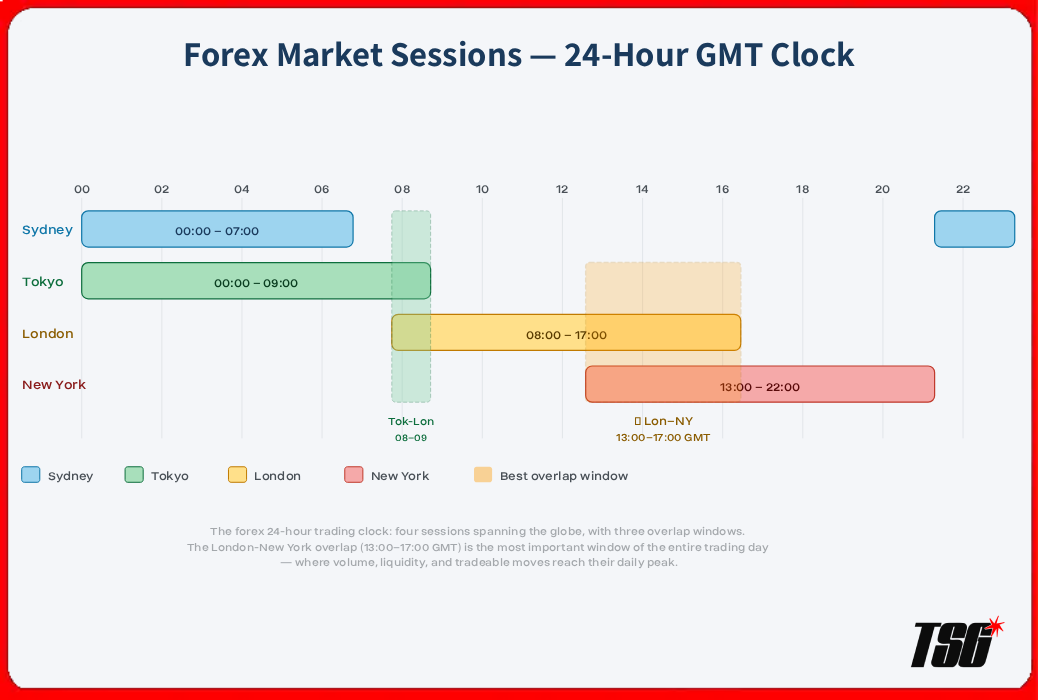
The forex market operates continuously because the world’s major financial centers span every time zone. As one center closes for the business day, another opens. This creates asessionen chain of forex trading sessions — from Sunday evening, when Sydney opens, to Friday evening, when New York closes.
Currency exchange is a practical commercial necessity, not just a speculative activity. Companies transacting across borders, governments managing reserves, and banks settling international payments all require currency conversion at all hours. Major financial institutions transfer trading responsibility from one geographic desk to another as the day progresses. Therefore, the market never fully stops.
However, the market’s character changes dramatically depending on which financial centers are active. When London and New York operate simultaneously, exceptional liquidity, tight spreads, and decisive price moves define the session. When only Sydney is active, volume drops to a fraction of that level. This contrast is why understanding the forex market open time by session is essential for every trader.
|
5.2
The Four Major Trading Sessions
Each forex trading sessions corresponds to the business hours of a major financial center. Understanding each session’s character — typical volume, active pairs, and key events — lets you match your schedule to the conditions that best suit your strategy.
Forex Market: Global Trading Sessions Overview
| Session | GMT Hours | Global Volume Share | Dominant Center | Defining Characteristic |
|---|---|---|---|---|
| Sydney | 22:00 – 07:00 | ~5% | Sydney, Australia | Lowest volume; opens weekly market; reacts to weekend news |
| Tokyo | 00:00 – 09:00 | ~6% | Tokyo, Japan | JPY pairs dominate; range-bound EUR/USD and GBP/USD |
| London | 08:00 – 17:00 | ~38% | London, UK | Highest single-session volume; dramatic spread tightening at open |
| New York | 13:00 – 22:00 | ~17% | New York, USA | US data drives volatility; peak quality during London overlap |
Sydney Session (22:00–07:00 GMT)
The Sydney session has the smallest trading volume. It opens the weekly forex market on Sunday at 22:00 GMT. Despite modest volume, it plays a key role. It is the first session to react to weekend news and events — sometimes creating a gap from Friday’s closing price.
The Australian dollar (AUD) and New Zealand dollar (NZD) are the most active currency pairs during this session. The Reserve Bank of Australia and the Reserve Bank of New Zealand both release their data during Sydney hours. EUR/USD and GBP/USD carry relatively low volume and wider spreads. Avoid these pairs unless a major news event demands attention. The Sydney-Tokyo overlap (00:00–02:00 GMT) creates a modest pickup in volume. This window is the best time of day to trade the AUD/JPY and NZD/JPY cross-currency pairs.
Tokyo Session (00:00–09:00 GMT)
The Tokyo session brings Asian liquidity into the market. It is particularly important for Japanese yen pairs. Approximately 6% of global daily forex volume flows through Tokyo — meaningfully larger than Sydney but far behind London and New York.
USD/JPY is the defining pair of this session. The Bank of Japan’s policy decisions, Japanese economic data, and yen intervention from the Ministry of Finance all occur during Tokyo hours. EUR/JPY and GBP/JPY also show increased activity. They inherit yen volatility from the session’s dominant themes. EUR/USD and GBP/USD typically trade in range-bound price action during Tokyo. Breakout traders should exercise caution on Tokyo-session breakouts for European pairs — these moves frequently reverse when London opens.
London Session (08:00–17:00 GMT) — The Most Important
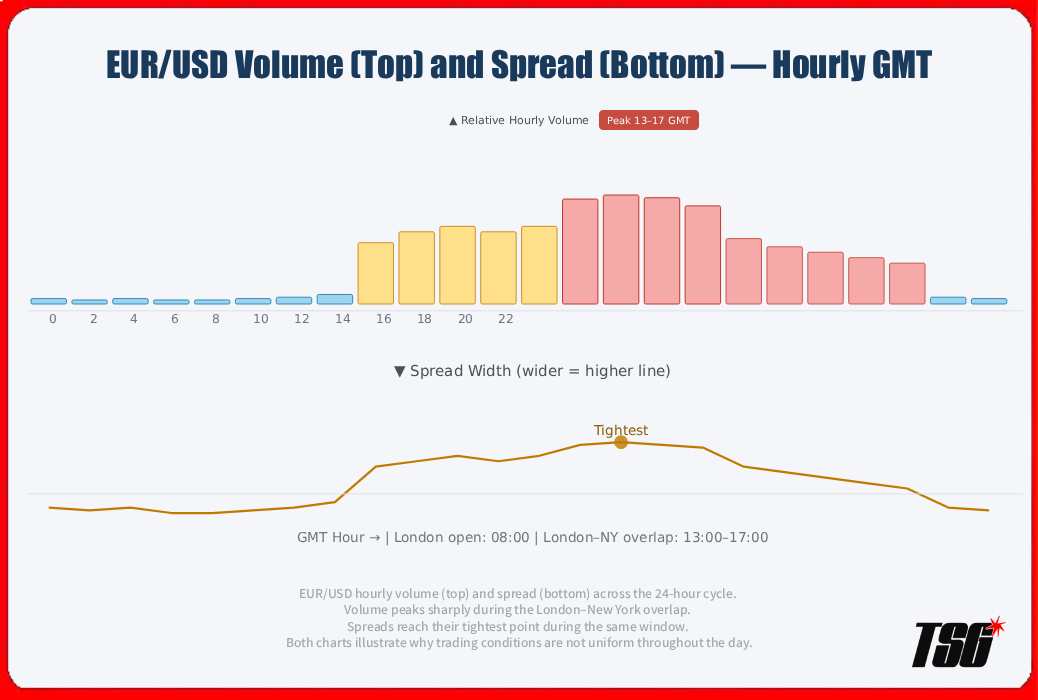
London is the world’s largest forex trading center. It accounts for approximately 38% of all global daily volume. When London opens at 08:00 GMT, the market undergoes a dramatic transformation. Spreads tighten instantly, volume surges, and price moves become more decisive and technically reliable.
The London open (08:00–10:00 GMT) is one of the most significant events of the trading day. Major banks open their order books during this window. Institutional flows from the Asian session resolve themselves. The day’s directional bias often begins to establish itself at this point. EUR/USD, GBP/USD, and EUR/GBP all reach their daily liquidity peak during London hours. Key UK and eurozone economic data — GDP, CPI, retail sales, and PMI — creates sharp, high-momentum moves on affected pairs. The 09:30 GMT window, when UK economic data is typically released, is one of the most reliably volatile moments of the trading week for GBP pairs.
|
New York Session (13:00–22:00 GMT)
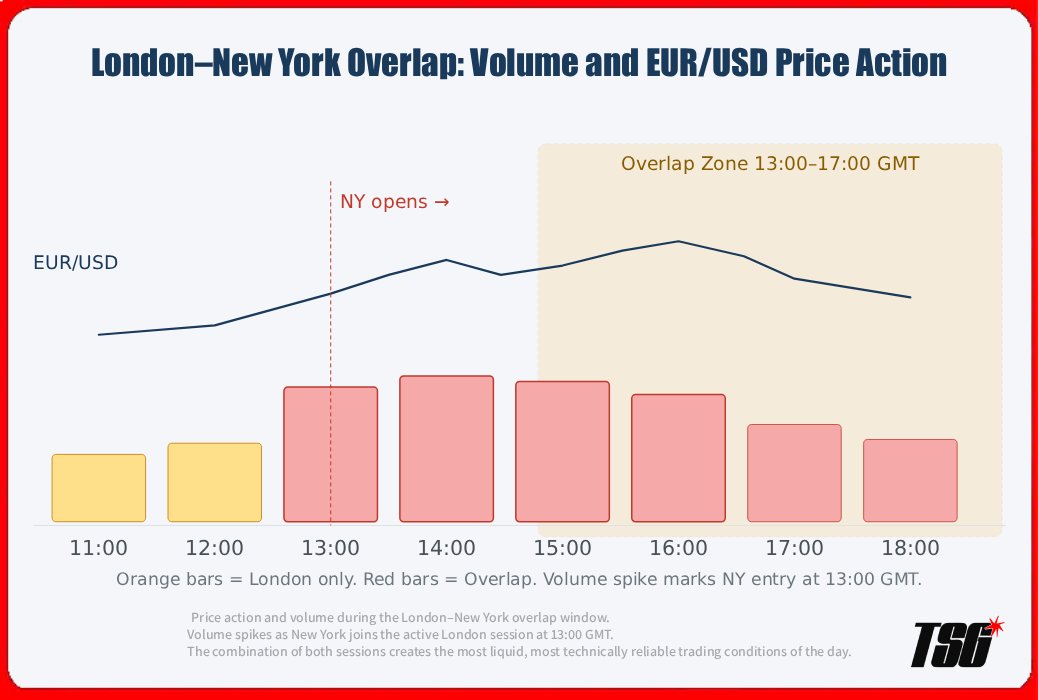
New York handles approximately 17% of global daily volume. It is the second-largest forex trading center in the world. The New York session’s most important characteristic is not what happens when it trades alone — it is what happens when it overlaps with London between 13:00 and 17:00 GMT.
During the first four hours of the New York session, London banks remain fully active. This creates the highest-volume, highest-liquidity window in the entire 24-hour cycle. After London closes at 17:00 GMT, New York continues with reduced but still meaningful volume — particularly in USD-denominated pairs.
The New York session is defined by US economic data releases. Non-Farm Payrolls (released on the first Friday of each month at 13:30 GMT), CPI, Federal Reserve meeting statements, and retail sales figures all create dramatic, high-velocity moves in USD pairs. USD/CAD is particularly active as Canadian economic data also coincides with New York trading hours.
5.3
Session Overlaps: The Best Time to Trade
An overlap occurs when two major currency trading sessions are simultaneously active. During these windows, the combined volume of two financial centers creates conditions of exceptional liquidity. Tighter spreads, faster execution, more decisive price moves, and more reliable technical setups all characterize the overlap periods.
For most beginner traders with flexible schedules, these overlaps are the optimal times to trade. Furthermore, overlaps reduce the risk of widespread surprises and erratic price behavior that commonly occur during quiet, single-session periods.
London–New York Overlap (13:00–17:00 GMT) — The Premier Window
The London–New York overlap is the most important four-hour window in the entire forex trading week. It accounts for a disproportionately large share of daily volume and features the tightest spreads of the day. During this period, EUR/USD typically produces its most decisive moves alongside the most consistently reliable technical signals.
US economic data released at 13:30 or 15:00 GMT creates high-momentum opportunities. Professional traders specifically position for these releases. The combination of European and American institutional order flow creates market conditions where chart patterns and breakouts are most likely to follow through. For traders who can only access the market for a few hours per day, the London–New York overlap must be the non-negotiable priority.
|
Tokyo-London Overlap (08:00–09:00 GMT)
The Tokyo–London overlap is a much shorter and more modest window. It lasts just one hour. Asian banks have not yet closed. European banks are just beginning to open. During this window, JPY pairs carry over activity from the Tokyo session, while EUR and GBP pairs start to see increasing London volume.
The most important event in this overlap is the London open itself at 08:00 GMT — the preceding 30 minutes (07:30–08:00 GMT) often produce tight consolidation that breaks decisively when European order flow arrives. For traders specializing in EUR/JPY or GBP/JPY, this is the most active period of the day. Both currencies are simultaneously driven by their respective financial centers.
5.4
Best Currency Pairs for Each Forex Market Sessions
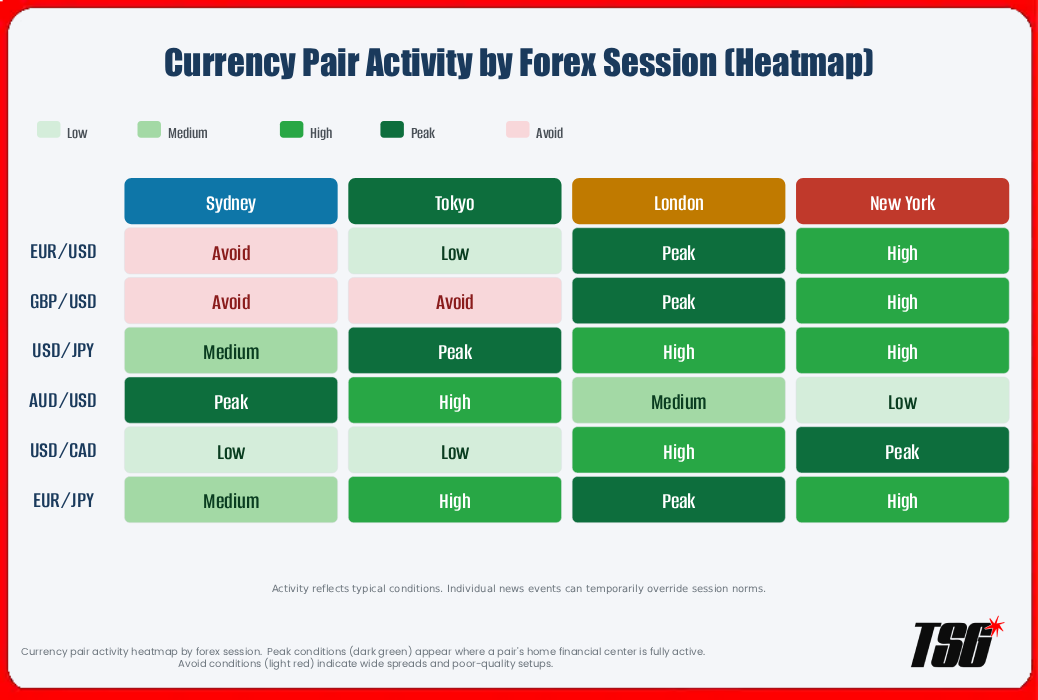
Trading the wrong pair for the active session is one of the most common beginner mistakes. Every currency pair has a natural session — the period when its home financial centers are open, and liquidity is highest. Trading outside that window means accepting wider spreads, lower-quality setups, and more erratic price behavior.
Additionally, understanding which pairs to avoid during specific sessions protects your capital from unnecessary spread costs. Below is a comprehensive reference for every session in the forex market trading sessions cycle.
Trading Strategy: Recommended Currency Pairs by Forex Market Sessions
| Session | GMT Hours | Primary Pairs | Secondary Pairs | Avoid |
|---|---|---|---|---|
| Sydney | 22:00–07:00 | AUD/USD, NZD/USD | AUD/JPY, NZD/JPY | EUR/USD, GBP/USD (low volume, wide spreads) |
| Tokyo | 00:00–09:00 | USD/JPY, EUR/JPY | AUD/USD, AUD/JPY | GBP pairs (range-bound, poor follow-through) |
| London | 08:00–17:00 | EUR/USD, GBP/USD, EUR/GBP | All major pairs active | Exotic pairs (spreads remain elevated) |
| New York | 13:00–22:00 | EUR/USD, USD/CAD | USD/JPY, GBP/USD | AUD/NZD (very low volume after 17:00 GMT) |
| Lon–NY Overlap | 13:00–17:00 | ALL major pairs — peak conditions | EUR/USD leads all pairs | Nothing — best window of the full day |
The table above also functions as a quick reference for building your Trading Program. Match your available trading hours to the session that aligns with your preferred pairs. Then apply the rules consistently over weeks and months to develop accurate performance data.
Key Selection Principles for Pair-to-Session Matching:
- Trade AUD and NZD pairs exclusively during Sydney and early Tokyo hours — this is when their central banks are active, and data is released.
- Trade USD/JPY during Tokyo hours — the Bank of Japan operates during this window, and yen-specific news lands here first.
- Trade EUR/USD and GBP/USD during London or the London–New York overlap — these pairs need European institutional volume to generate reliable setups.
- Avoid exotic pairs in all but the London and early New York sessions — spreads remain prohibitively wide everywhere else.
- USD/CAD is a New York specialist — Canadian data releases align with New York hours, and the pair sees its deepest liquidity during this session.
5.5
When Not to Trade: News Events and Low Liquidity
Knowing when to trade is only half of the equation. Knowing when NOT to trade is equally — and sometimes more — important for preserving capital. Certain windows consistently create poor trading conditions that disproportionately harm beginners. Wide spreads, erratic price action, massive slippage on stop-losses, and high-failure technical setups define these periods.
Moreover, many new traders experience their worst losses not from bad analysis but from trading during these dangerous windows. Avoiding them is one of the simplest and most effective risk management decisions available. The following table identifies the five key danger zones in the forex market sessions cycle.
Risk Mitigation: High-Risk Windows and Non-Trading Periods
| Window | GMT Times | Risk Level | Primary Dangers | Recommendation |
|---|---|---|---|---|
| High-Impact News | ±30 min of release | 🔴 Extreme | Spreads widen 2–4×; high slippage on stops. | Close or hedge before red-flagged data releases. |
| Friday Market Close | 20:00 – 22:00 | 🔴 High | Sharp volume drop; weekend gap exposure. | Flat all positions by 20:00 GMT Friday. |
| Sunday Market Open | 22:00 – 23:00 | 🟠 High | Erratic gap pricing; very low liquidity. | Allow first hour to settle before entry. |
| Off-Hours Dead Zone | 22:00 – 00:00 | 🟠 Medium-High | Post-NY / Pre-Sydney; extremely thin liquidity. | Avoid major pairs; limit to AUD/NZD instruments. |
| Pure Sydney (Non-Overlap) | 00:00 – 07:00 | 🟡 Moderate | Poor-quality setups for EUR/USD & GBP/USD. | Restrict to AUD and JPY crosses only. |
|
High-impact news events deserve special attention. A stop-loss that should trigger at 30 pips may execute at 60 or 80 pips during a major release due to slippage. The risk is asymmetric. The downside of being wrong during the news is significantly worse than in normal conditions. Meanwhile, your technical setup loses predictive value in the face of news-driven volatility.
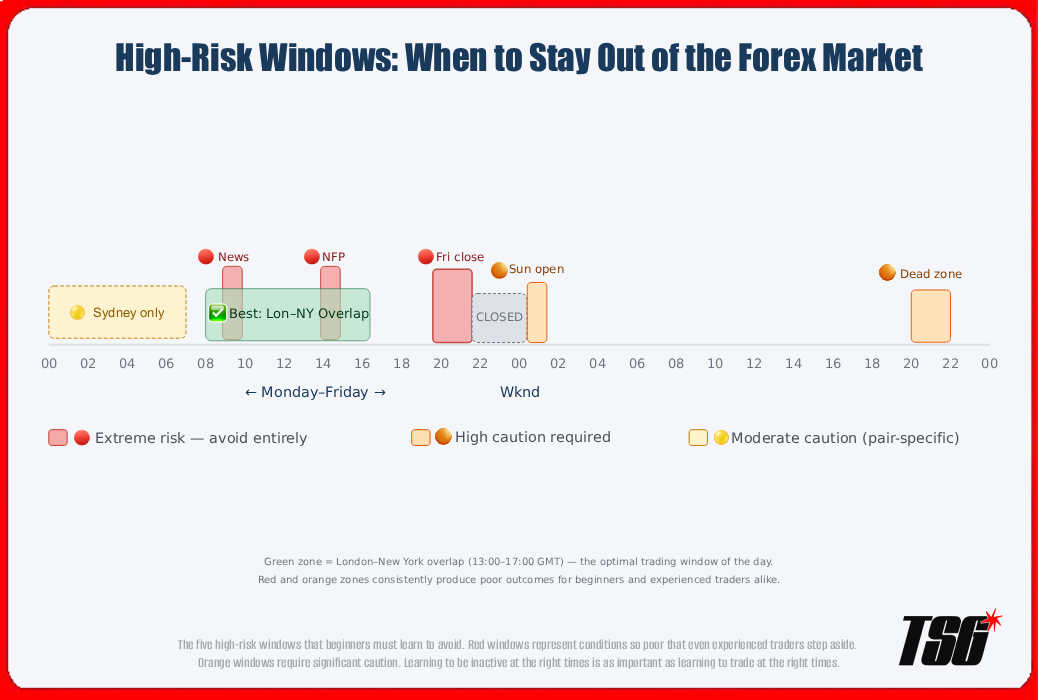
Finally, weekend gap risk is a real and underappreciated danger. Any position held over the weekend is exposed to events that occurred while the market was closed. The price at Sunday’s open may differ significantly from Friday’s close, with no opportunity to exit in between. Closing all positions before the Friday market close eliminates this risk entirely.
5.6
Building Your Trading Program Around Forex Market Sessions
Understanding forex market sessions is not just theoretical knowledge. It is the foundation of a practical and sustainable Trading Program. The most disciplined traders do not trade every hour the market is open — they trade a specific, well-chosen window consistently, day after day.
Furthermore, consistency across a fixed session window is what allows you to build accurate performance data. If you trade during the London–New York overlap every day for three months, you generate statistically meaningful information about your strategy’s performance under a consistent set of market conditions. Trading randomly across sessions makes performance data meaningless. Consider these principles when structuring your Trading Program:
- Choose one or two sessions that match your schedule. Forcing yourself to wake at 03:00 GMT for the London open is unsustainable. Trade the session you can attend consistently and alertly.
- Start every session by checking the economic calendar. Mark all red (high-impact) events on pairs you intend to trade. Plan your risk accordingly before the session begins.
- Match your currency pairs to your chosen session. Use Table 3 as your daily reference guide. Do not trade EUR/USD during the Tokyo session just because you are awake.
- Avoid trading the 30 minutes before and after any high-impact news release. This rule alone eliminates a significant proportion of beginner losses from slippage.
- Track your results by session. After 60 days, review whether your win rate, average pip gain, and risk/reward ratio differ across sessions. Then reallocate your trading hours to your best-performing window.
Trading Routine: Sample Weekly Program by Forex Market Sessions
| Day | Session Focus | GMT Hours | Priority Pairs | Key Events to Watch |
|---|---|---|---|---|
| Monday | London + Overlap | 08:00 – 17:00 | EUR/USD, GBP/USD | Eurozone PMI releases; early week positioning |
| Tuesday | London + Overlap | 08:00 – 17:00 | EUR/USD, USD/JPY | UK CPI (09:30 GMT); US consumer data (13:30 GMT) |
| Wednesday | London + Overlap | 08:00 – 17:00 | EUR/USD, GBP/USD | US ADP employment (13:15 GMT); FOMC minutes |
| Thursday | London + Overlap | 08:00 – 17:00 | GBP/USD, EUR/USD | ECB/BOE decisions (12:45 GMT); US jobless claims |
| Friday | London only (closes early) | 08:00 – 17:00 (exit by 19:30) |
EUR/USD (NFP day only) |
Non-Farm Payrolls (13:30 GMT); close all by 20:00 |
|
The schedule above represents the simplest and most reliable approach for a beginner following a structured Trading Program. It concentrates all activity during the London session and the London–New York overlap. Consequently, it captures the highest-quality trading conditions available all week. It also avoids all known high-risk windows by design.
As your skills develop, you can optionally add a Tokyo session component — specifically for USD/JPY or EUR/JPY. However, resist the urge to trade every session simultaneously. Depth of performance in a single window consistently outperforms breadth across multiple windows for developing traders.
5.7
Quick-Reference Summary: Forex Market Sessions
The following table consolidates all forex market sessions times and trading guidance into a single reference you can bookmark. Use it alongside the economic calendar before every trading session.
Master Forex Market Sessions Times Reference: Global Liquidity Map
| Session | GMT Open | GMT Close | Quality | Best Pairs | Avoid |
|---|---|---|---|---|---|
| Sydney | 22:00 | 07:00 | 🟡 Low–Moderate | AUD/USD, NZD/USD | EUR/USD, GBP/USD |
| Tokyo | 00:00 | 09:00 | 🟡 Moderate | USD/JPY, EUR/JPY | GBP/USD, GBP cross pairs |
| Tok–Lon Overlap | 08:00 | 09:00 | 🟢 Good | EUR/JPY, GBP/JPY | AUD exotics |
| London | 08:00 | 17:00 | 🟢 Very Good | EUR/USD, GBP/USD, EUR/GBP | Exotic pairs |
| ⭐ Lon–NY Overlap | 13:00 | 17:00 | 🏆 Peak — Best of Day | ALL majors — EUR/USD leads | Nothing — trade everything |
| New York | 13:00 | 22:00 | 🟢 Good (13–17) 🟡 Moderate (17–22) |
EUR/USD, USD/CAD, USD/JPY | AUD/NZD after 17:00 |
| Off-Hours Dead Zone | 22:00 | 23:00 | 🔴 Avoid | — | All pairs |
5.8
Conclusion: Mastering Forex Market Sessions Changes Everything
Most beginners ask, “Which pair should I trade?” The more important question is “when should I trade it?” Mastering the forex market session cycle transforms a random collection of trades into a disciplined, structured Trading Program with measurable, improvable results.
The core principles of this guide are simple and worth repeating:
- The London–New York overlap (13:00–17:00 GMT) is the best four-hour window in the trading week. Prioritize it above everything else.
- Every pair has a natural session. Trade EUR/USD and GBP/USD during London and the overlap. Trade USD/JPY during Tokyo. Trade AUD/USD during Sydney and early Tokyo.
- The economic calendar is not optional. Check it every day before trading. Avoid all positions 30 minutes before and during high-impact releases.
- Close all positions before Friday’s 20:00 GMT. Never hold positions over the weekend.
- Consistency in one good session always outperforms randomness across many sessions for developing traders.
Finally, understanding how currency trading sessions interact with pips, leverage, and margin gives beginners an enormous practical advantage. Most new traders lose money not because their analysis is wrong, but because they trade in conditions that are structurally stacked against them. Trading the right pair at the right time in the right forex market session is the single most controllable variable available to every retail trader, regardless of strategy or experience level.
|
5.9
Frequently Asked Questions
Q: What is the best time to trade forex for a beginner?
The London-New York overlap (13:00–17:00 GMT) is the best time to trade for any level of experience. During this window, EUR/USD and GBP/USD have their tightest spreads, highest volume, and most reliable technical behavior. For part-time traders who cannot access this window, the London session open (08:00–10:00 GMT) is the second-best option — it has excellent liquidity and produces reliable breakout opportunities as European institutional flows begin.
Q: Do forex market hours change with daylight saving time?
Yes. When the UK moves its clocks forward in late March (BST), and when the US moves forward in March as well, session times in GMT shift. The London-New York overlap typically shifts between 13:00–17:00 GMT (winter) and 13:00–17:00 GMT (summer, BST) — though the clocks in the UK and US do not change on the same date, creating a brief period where the overlap is 14:00–18:00 GMT. The best solution is to check a live forex session clock (available free at Babypips.com or Forexfactory.com) rather than memorizing fixed times.
Q: Is it possible to trade profitably outside the London-New York overlap?
Yes, but it requires adjusting your approach. The Tokyo session offers excellent conditions for USD/JPY and AUD/JPY pairs where the relevant central banks are active, and volumes are meaningful. The London session open is a well-documented setup window with reliable breakout characteristics. What is genuinely difficult — and not recommended for beginners — is trading European pairs like EUR/USD and GBP/USD during the Tokyo or Sydney sessions, where low volume creates false moves and wide spreads erode profitability.
Q: What happens to my open positions during the weekend gap?
Over the weekend, the forex market is closed from approximately 22:00 GMT Friday to 22:00 GMT Sunday. During this period, prices cannot adjust to news or events. When the market reopens on Sunday evening, it opens at whatever price reflects the weekend’s developments, which may be significantly different from Friday’s close. This gap creates immediate profit or loss on any position that was held open. Most experienced traders close short-term positions before the weekend and only hold longer-term positions where they have pre-defined risk parameters that accommodate potential gaps.
Q: How do I find out when important economic releases are scheduled?
The best free economic calendars for forex traders are Forexfactory.com and Investing.com. Both allow you to filter by impact level (high, medium, low) and by currency. Set up a daily habit: before each trading session, check what high-impact events are scheduled for that day and the following 24 hours. Events rated ‘high impact’ (red on most calendars) are the ones capable of moving currency pairs 50–200+ pips within seconds — these require either closing positions beforehand or ensuring your stop-loss is set well outside the likely spike range.
5.7
Quiz
| → Continue Reading
You know when to trade. Next, learn how orders are filled: Understanding Forex Order Types — Market, Limit, Stop, and More. |