
4.1
What Is Leverage in Forex?
Understanding leverage and margin starts with one simple truth: they are two sides of the same risk equation. To begin with, leverage is borrowed capital your broker provides, allowing you to control a position far larger than your actual account balance. When a broker offers 100:1 leverage, you control $100,000 worth of currency with just $1,000 of your own money. Furthermore, the broker provides the remaining $99,000 as temporary credit, which exists only while your trade remains open.
Consequently, the appeal is obvious. Instead of needing $100,000 to trade one standard lot of EUR/USD, you only need $1,000. As a result, your buying power multiplies by 100. However, this multiplication applies to both profits and losses with complete, unforgiving symmetry.
In addition, the broker does not share in your losses. It simply closes your position automatically when your equity runs out. Ultimately, this is leverage and margin stripped to their core: amplified exposure on one side, collateral obligation on the other. Trading with a leverage ratio means you always work with borrowed size; you must be prepared to lose it. The margin secures the borrowed size every second the trade is open.
Understanding this relationship before you trade is not optional. It is the foundation on which every other concept in this guide builds.
Visual Analysis: Leverage and Margin Price Impact
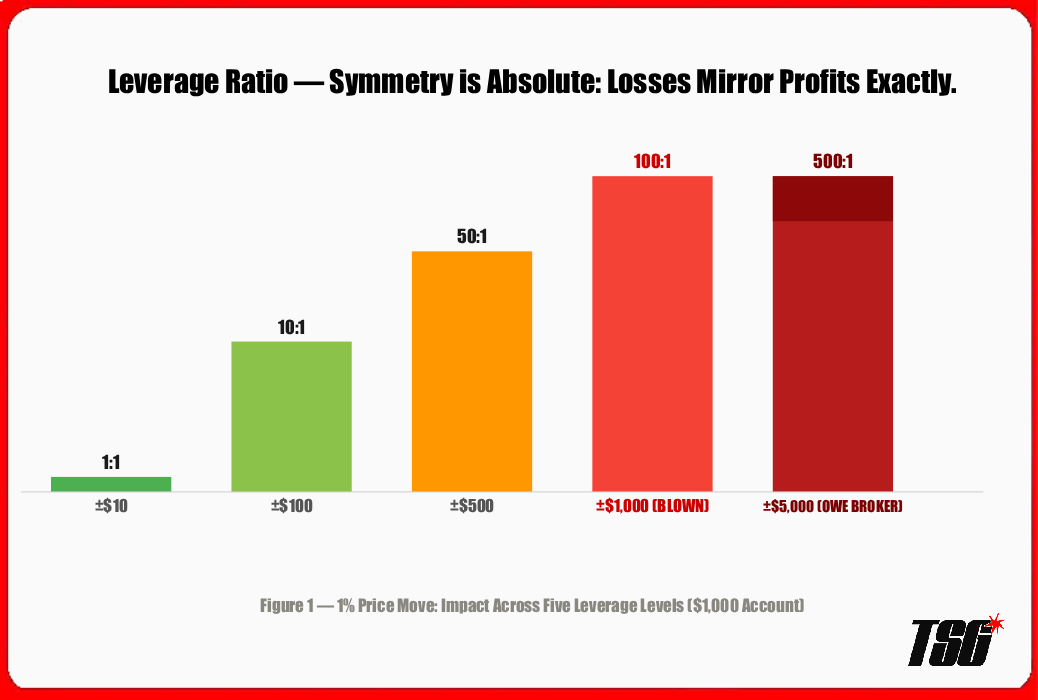
Figure 1 — The same 1% price move across five leverage levels on a $1,000 account. At 1:1 (no leverage), a 1% move gains or loses $10. At 100:1, the same move gains or loses $1,000 — your entire account. At 500:1, you owe money beyond your balance. Symmetry is absolute.
Indeed, the chart above confirms one truth: the same 1% price move becomes catastrophic as leverage rises. Specifically, at 1:1, it costs $10. In contrast, at 100:1, it costs everything. Examine the precise numbers by leverage ratio in the table below.
Risk Management: Leverage Ratios & Capital Impact Analysis
| Leverage Ratio | Position per $1,000 Account | 1% Move Impact & Account Result |
|---|---|---|
| 1:1 (No Leverage) | $1,000 position | ±$10 loss/gain — 1% of account |
| 10:1 | $10,000 position | ±$100 loss/gain — 10% of account |
| 50:1 | $50,000 position | ±$500 loss/gain — 50% of account |
| 100:1 | $100,000 position | ±$1,000 — Account fully blown (100 pips) |
| 500:1 | $500,000 position | ±$5,000 — Trader owes broker (20 pips) |
|
How Leverage and Margin Amplify Both Profits and Losses
The core equation of leverage trading is simple and unforgiving:
Profit or Loss = Price Move × Position Size
Because position size is what leverage controls. With 100:1 leverage and a $1,000 account, your position size reaches $100,000. Consequently, a 1% adverse move against that position produces a $1,000 loss — equal to 100% of your account equity. One trade. One percent. Everything gone.
Conversely, compare that to an unleveraged stock position. A $1,000 investment with no leverage loses $10 on a 1% move. In this case, position, account, and trader all survive. In leveraged forex trading at 100:1, that identical 1% move is a total wipeout.
Moreover, leverage does not improve your strategy. It does not increase your edge. Instead, it magnifies whatever outcome the market delivers, gains and losses, at the exact same rate, with complete symmetry. Typically, most brokers show only the profit side of that symmetry in their marketing. The loss side is identical and equally guaranteed.
|
Leverage Analysis: Capital Exposure and Liquidation Thresholds
| Leverage Ratio | Position per $1,000 | 1% Loss | Pips to Blow Account* |
|---|---|---|---|
| 1:1 (No Leverage) | $1,000 | $10 (1% of account) | 10,000 pips |
| 10:1 | $10,000 | $100 (10% of account) | 1,000 pips |
| 50:1 | $50,000 | $500 (50% of account) | 200 pips |
| 100:1 | $100,000 | $1,000 (Account Blown) | 100 pips |
| 500:1 | $500,000 | $5,000 (Owe Broker) | 20 pips |
|
4.2
Defining the Mechanics of Margin and Leverage
What Is Margin?
The relationship between leverage and margin is frequently misunderstood — margin is neither a fee nor a cost. Rather, margin is the collateral your broker holds from your account to cover potential losses on your open positions. Notably, it sits in your account but remains temporarily unavailable while your trade is open. Subsequently, the moment you close the trade, your margin is immediately available for free use.
In fact, the connection between leverage and margin is direct and mathematical. If your broker offers 100:1 leverage, it requires 1% of the position value as margin. A $100,000 position requires $1,000 of margin. Thus, every leverage ratio has an exact margin equivalent.
Furthermore, if your broker offers 50:1 leverage, it requires 2% — a $100,000 position requires $2,000 of margin. Higher leverage means lower margin requirements; lower leverage means higher margin requirements. Trading on margin, therefore, describes a system where you control large positions using only a fraction of their total value as a security deposit. This fraction — your margin — determines your true risk exposure at all times.
Surprisingly, many beginners misread falling margin as a fee drain. Actually, it is not. It is a direct warning signal about position size and leverage exposure.
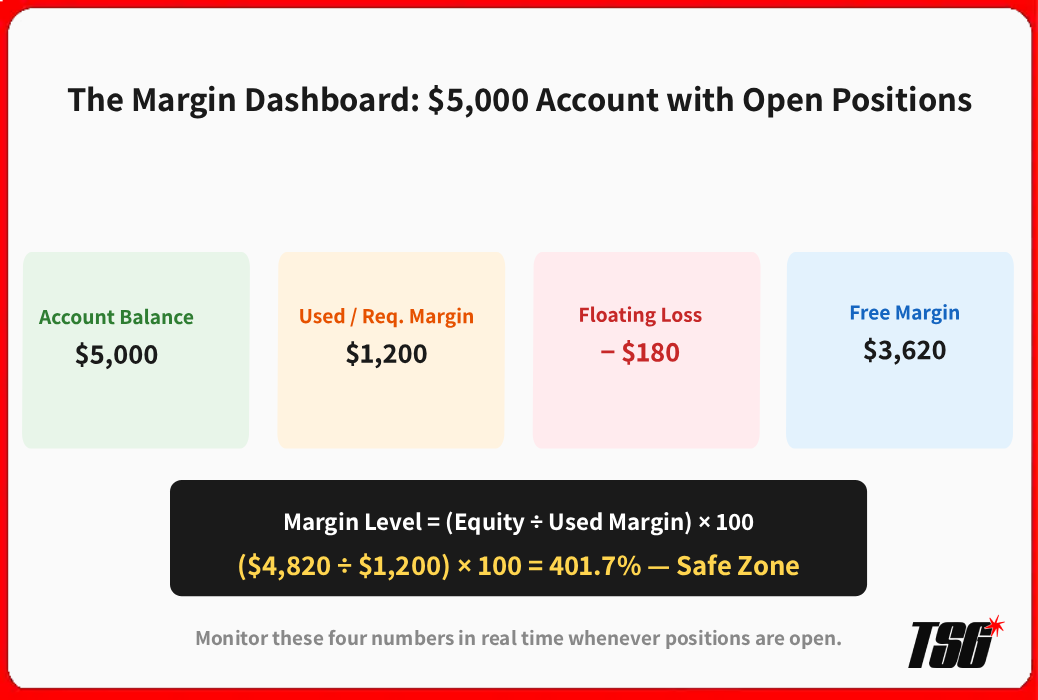
Figure 2 — The margin dashboard: a $5,000 account with open positions showing required margin ($1,200), floating loss (-$180), free margin ($3,620), and margin level (307%). Understanding these four numbers in real time is essential for safely managing open positions.
Basically, the dashboard above shows four critical numbers every active trader must track. Significantly, the free margin and the margin level together determine your account’s survival capacity. The following table clarifies each margin type, its definition, and the practical signal it sends regarding your leverage and margin exposure.
Margin Management: Definitions and Operational Trading Signals
| Margin Type | Definition | Practical Signal for Traders |
|---|---|---|
| Required Margin | Amount locked per open position as collateral. At 100:1, a $10,000 mini lot requires $100. | Rises with every new position. Unavailable for other trades until the position closes. |
| Used Margin | Total of all required margins across all open positions simultaneously. | Three positions at $100, $150, and $200 each produce a $450 used margin. |
| Free Margin | Equity minus used margin. Capital available to open new trades or absorb further losses. | Declining free margin is the earliest warning signal of account pressure. Monitor constantly. |
| Margin Level % | (Equity ÷ Used Margin) × 100. Expressed as a real-time percentage in your platform. | Below 200%: review exposure. Below 100%: margin call imminent. |
Leverage and Margin Levels: Why They Matter
Monitoring leverage and margin level in real time is the most important habit you can build. Monitoring leverage and margin level in real time is the most important habit you can build. For example, a margin level of 500% means your equity is five times your used margin. On the other hand, a margin level of 150% means you are entering the danger zone. Eventually, a margin level of 100% is where a broker issues a formal margin call.
Your platform displays this number continuously. Check it whenever you hold open positions. Do not wait for the broker to contact you first.
Margin Level = (Equity ÷ Used Margin) × 100
In short, a margin level below 200% demands an immediate review of your total leverage and margin exposure. At 150%, reduce your position size before your broker is forced to act. At 100%, one additional bad trade will trigger automatic liquidation without further warning. The margin level is not a suggestion — it is a countdown timer. Act early, not reactively after the damage occurs.
This is leverage and margin at their most actionable: a live measure of how much buffer stands between you and forced position closure.
|
4.3
The Final Result: Leverage and Margin Stop-Outs
When account equity falls below the amount required by open positions, your broker takes automated action. Specifically, this sequence unfolds in two distinct stages: the margin call and the stop-out, and neither waits for your permission. Usually, most brokers issue a margin call when your margin level reaches 100% and execute a stop-out at 50%. Always verify the exact levels in your account agreement before placing your first trade.
Initially, at the margin call level, the broker warns you that your leverage and margin balance are critically low. Subsequently, at the stop-out level, positions close automatically — largest loss first — without exception.
Many traders discover these thresholds exist only after they trigger them. Checking your broker-specific margin call and stop-out levels before you trade is not optional — it is basic account management. A broker operating at 80% stop-out gives you less room than one at 50%. Know the exact numbers. Write them down. Keep them visible during every session.
Leveraging forex exposure without this knowledge is like driving at speed without knowing where the cliff ends.
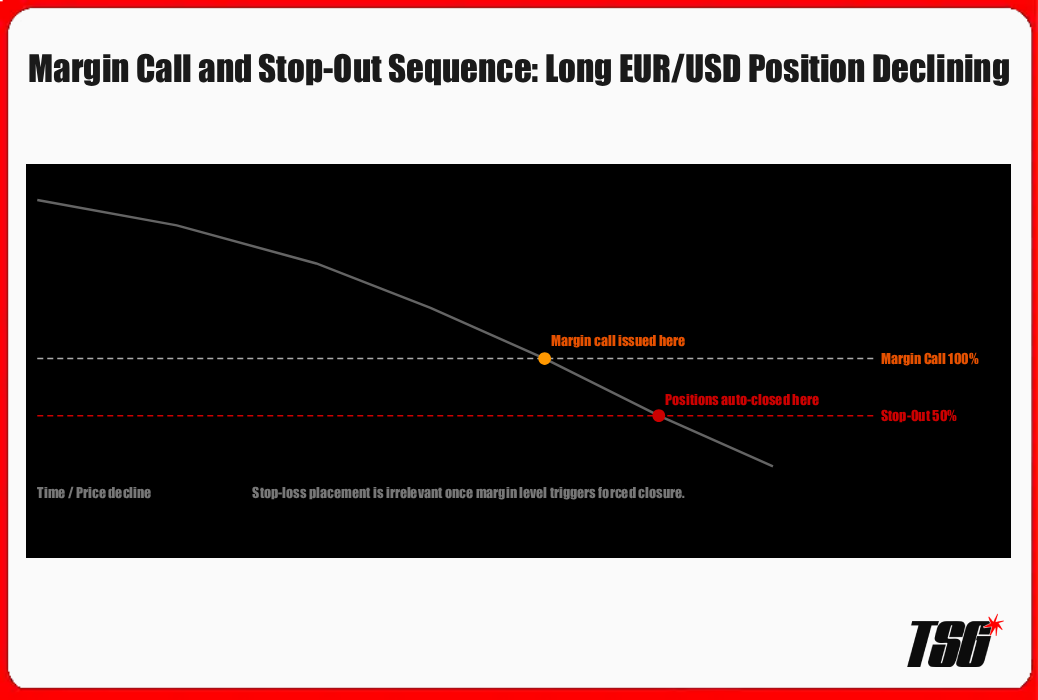
Figure 3 — Price declining against a long EUR/USD position. As equity falls, the margin level drops. At 100% margin level, the broker issues a margin call. At 50% margin level, positions are stopped out automatically — regardless of where the market is or where your intended stop-loss was.
Clearly, the sequence above illustrates the critical point: your intended stop-loss becomes irrelevant once the stop-out threshold is reached. The broker’s automated system closes your largest losing position first, regardless of your instructions. To illustrate, consider the two concrete calculations below, which show exactly how leverage and margin interact as this sequence unfolds.
How to Calculate Leverage and Margin Call Thresholds
Consider a $2,000 account balance with $800 in used margin and a losing trade of −$1,000. Equity equals $1,000. Margin level equals ($1,000 ÷ $800) × 100, producing 125%. You are approaching but have not yet reached the 100% margin call level. Your equity needs to fall another $200 before the margin call triggers. That gap disappears quickly during volatile sessions.
Using that same account, suppose equity falls to $400. Margin level equals ($400 ÷ $800) × 100, which equals 50%. Your broker system immediately begins closing positions — largest loss first — with no further warning and no regard for your leverage and margin preferences.
Your stop-loss order is completely irrelevant at this point. The stop-out executes regardless of where your manual stop was placed, the current market price, or whether you are watching the screen. This is why position sizing and margin level monitoring matter far more than any individual stop-loss order. A correctly sized position in leveraged forex trading never approaches the stop-out threshold.
Calculate your margin call thresholds before every significant trade. The math takes thirty seconds. The benefit is permanent account protection.
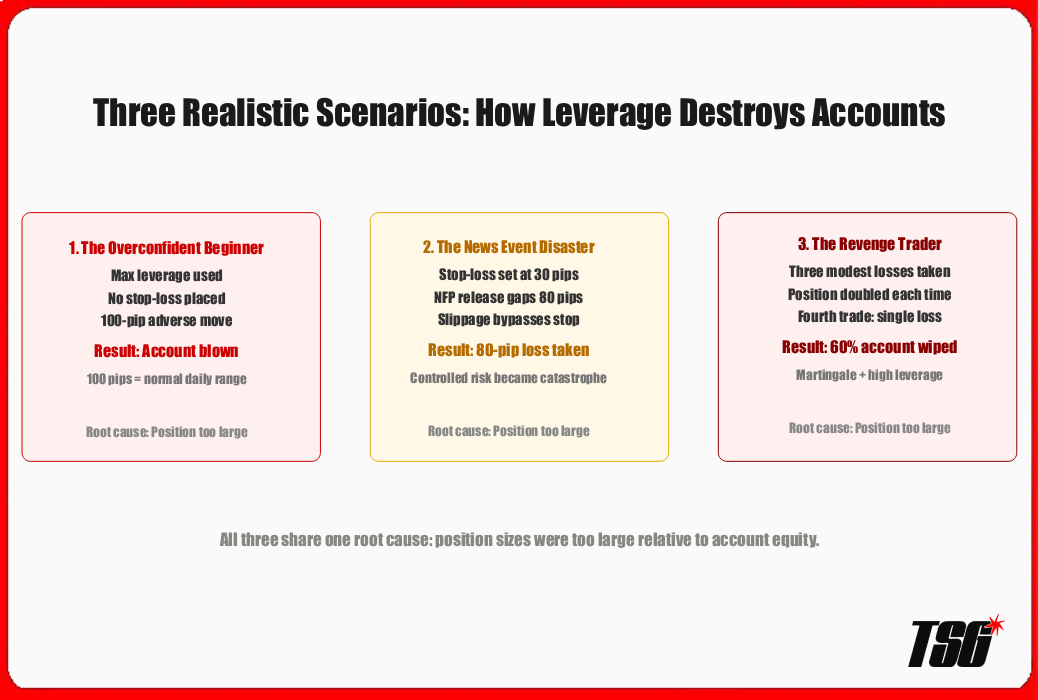
Figure 4 — Three realistic scenarios showing how leverage destroys accounts. All three involve different mistakes — oversizing, news-event slippage, and revenge trading — but they all share the same root cause: position sizes are too large relative to account equity.
Real-World Leverage and Margin Failures: Blown Accounts
Three distinct mistakes. Three identical root causes. Position size relative to account equity destroys accounts — not market conditions alone. The three scenarios above represent the most common patterns in beginner forex account failures, all rooted in mismanaged leverage and margin.
The Overconfident Beginner uses maximum leverage on a full account, places no stop-loss, and loses everything to a 100-pip move — a perfectly normal daily range for EUR/USD. The News Event Disaster has a stop-loss in place, but during a Non-Farm Payrolls release the price gaps 80 pips past it. Slippage on high-impact news converts a controlled 30-pip loss into an 80-pip catastrophe, and high leverage makes that catastrophe fatal. The stop-loss provided false security because the leverage and margin exposure were never appropriate for the account size.
The Revenge Trader compounds the damage further. After three modest losses, each recovery attempt doubles the position size. By the fourth trade, a single loss takes 60% of the account in seconds.
This is the compounding disaster of martingale thinking combined with uncontrolled leverage and margin exposure. The common thread across all three scenarios is not bad luck — it is position sizes that were too large relative to account equity from the very beginning. The same adverse price moves with correctly sized positions and disciplined risk management would have produced manageable 1–3% drawdowns. The market did not change. The risk management framework failed.
Smaller positions, conservative leverage, and consistent margin monitoring eliminate all three scenarios simultaneously. That is the entire solution — available to every trader right now.
4.4
Professional Standards: Recommended Leverage and Margin
How Much Leverage Should Beginners Actually Use?
Here is the truth the forex industry rarely publishes prominently. Professional traders almost never use their broker’s maximum available leverage — most experienced retail traders apply effective leverage of 5:1 to 20:1 at most. Not the 100:1 or 500:1 advertised on broker websites. Managing leverage and margin conservatively is the single decision that separates surviving traders from blown accounts.
Higher leverage does not increase your edge. It increases your exposure to the randomness of short-term price fluctuation, nothing more.
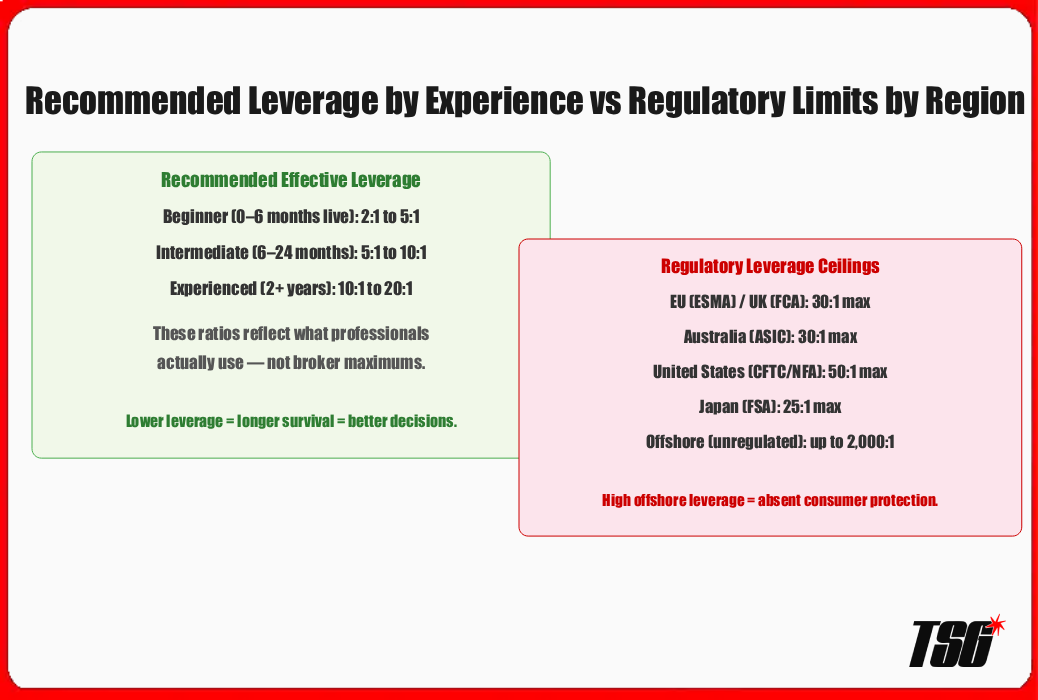
Figure 5 — Left: recommended effective leverage by experience level. Right: maximum leverage limits imposed by financial regulators in different regions. Note that offshore brokers offering 500:1 are not ‘better’ for traders — they simply operate with less consumer protection.
The market does not reward you for taking more leverage. It simply delivers faster feedback when you are wrong — and at 100:1 leverage, that feedback arrives as a blown account rather than a manageable loss. Lower leverage preserves capital. Preserved capital means more trades. More trades allow the law of large numbers to work in your favor over time. That is the entire competitive advantage of disciplined leverage and margin management.
Risk Allocation: Leverage Scaling & Risk Parameters by Experience Level
| Experience Level | Recommended Effective Leverage | Maximum Risk Per Trade |
|---|---|---|
| Beginner (0–6 months live) | 2:1 to 5:1 effective leverage | 0.5% to 1% of the account |
| Intermediate (6–24 months) | 5:1 to 10:1 effective leverage | 1% to 1.5% of the account |
| Experienced (2+ years) | 10:1 to 20:1 effective leverage | 1.5% to 2% of the account |
| Never Recommended | Above 50:1 effective leverage | Exceeds survivable drawdown |
Every additional leverage unit you remove from your trading adds months of survivability to your account.
The Professional Standard: 2:1 to 10:1 Effective Leverage
Effective leverage is the ratio of your total open position size to your account equity. It is not the maximum your broker allows — it is what you actually use right now. A $10,000 account with a $50,000 open position uses 5:1 effective leverage, regardless of whether the broker offers 500:1. This distinction is the heart of leverage and margin management. Your broker’s maximum is irrelevant. Your actual exposure is everything.
Research on retail forex trading consistently confirms that traders with lower effective leverage survive longer, maintain more consistent performance, and achieve better risk-adjusted returns than those trading at high leverage ratios.
This finding is not counterintuitive once you understand the mechanism. Low effective leverage keeps individual losing trades small, preserving capital for the next trade and allowing performance to develop across a statistically meaningful sample of trades. The practical formula for beginners: risk 1% of your account per trade, place your stop-loss at a technically justified level, and use the position sizing formula to determine your lot size. The resulting effective leverage will typically sit between 2:1 and 10:1 — well within the safe zone.
Apply this formula consistently, and you remove account destruction entirely from the list of possible outcomes.
|
Regulatory Leverage Limits by Region
Since 2018, major financial regulators have significantly reduced maximum leverage for retail traders. They acted in direct response to documented harm caused by excessive leverage and margin exposure in retail forex accounts across every major market.
Understanding these limits matters for two practical reasons:
- Legal Compliance: They affect which brokers you can legally use.
- Margin Requirements: They define the specific collateral your broker must hold against your positions.
Traders in regulated markets benefit from automatic consumer protections that their offshore counterparts lack.
Global Regulatory Framework: Maximum Leverage & Compliance Standards
| Region | Regulator | Max Leverage (Majors) | Key Compliance Rule |
|---|---|---|---|
| European Union | ESMA | 30:1 | Applies to all EU-licensed brokers |
| United Kingdom | FCA | 30:1 | Post-Brexit EU standards maintained |
| Australia | ASIC | 30:1 | Reduced from 500:1 in 2021 |
| United States | CFTC / NFA | 50:1 | FIFO rule (First In, First Out) |
| Japan | FSA | 25:1 | Most restrictive global standard |
| Offshore | None / Various | Up to 2000:1 | Zero consumer protection |
Regional Breakdown of Limits
The Asia-Pacific Landscape
Australia provides the clearest illustration of regulatory intent. Specifically, ASIC reduced maximum retail leverage from 500:1 to 30:1 in 2021—a 94% reduction—after studying leverage and margin loss data across the domestic retail forex market. Meanwhile, Japan remains the most restrictive globally, capping leverage at 25:1.
North American Standards
The United States caps major currency pairs at 50:1 through the CFTC and NFA. In addition to leverage caps, the U.S. imposes the FIFO (First-In, First-Out) rule, which dictates the order in which multiple positions in the same pair must be closed.
The European & UK Approach
Regulators in the EU (ESMA) and the UK (FCA) align closely with Australian standards, generally capping major forex pairs at 30:1.
Check your region’s regulatory framework before selecting a broker. The protection it provides is worth more than any leverage premium an offshore operator offers.
|
4.5
Frequently Asked Questions
Q: Can I lose more money than I deposited with leverage?
Yes — in theory, with some brokers. If the market gaps dramatically past your stop-loss and your account equity turns negative, you technically owe your broker the difference. However, most regulated brokers (FCA, ASIC, EU-regulated) offer negative balance protection, which means the maximum you can lose is your deposited amount. Always verify whether your broker provides negative balance protection before depositing. Unregulated offshore brokers may not offer this protection.
Q: What is the difference between leverage and margin?
Leverage and margin are two sides of the same coin. Leverage describes how much larger your position is than your account capital — expressed as a ratio (50:1 means your position is 50 times your margin). Margin describes how much of your account must be set aside as collateral — expressed as a percentage (2% margin requirement is the same as 50:1 leverage). Leverage = 1 ÷ Margin Requirement × 100. A 1% margin requirement equals 100:1 leverage; a 2% requirement equals 50:1 leverage.
Q: Does my broker charge interest on the leverage it provides?
Not directly on intraday positions. However, if you hold a leveraged position overnight, your broker charges or credits a rollover fee (also called a swap or financing charge) that reflects the interest rate differential between the two currencies in the pair. For most beginner trades held during the day and closed before the end of the trading day (approximately 22:00 UTC), there is no rollover cost. Swing traders holding positions for days or weeks need to factor rollover costs into their profit calculations.
Q: How do I know what leverage I am currently using?
Divide your total open position value by your account equity. In MT4/MT5, you can see your used margin and equity in the Trade tab at the bottom of the platform. Divide the position notional value (lot size × 100,000 for standard lots) by account equity to get your current effective leverage. Many brokers also display margin level as a percentage — a level above 1,000% indicates very low effective leverage; below 200% indicates dangerously high leverage relative to your equity.
Q: If leverage is so dangerous, why do brokers offer such high ratios?
Higher leverage increases trading frequency and volume, which increases broker revenue from spreads and commissions. A trader using 100:1 leverage will open larger positions, generate more spread revenue per trade, and — statistically — lose their account faster, necessitating another deposit. This is not a conspiracy; it is simply the reality of the retail forex business model. Regulated brokers must now provide risk warnings disclosing the percentage of accounts that lose money. Understanding this dynamic is part of being a sophisticated market participant.
4.6
Quiz
→ Continue Reading
You understand leverage risk. Now learn how forex is priced throughout the day: Forex Market Sessions — When to Trade and Why It Matters.