
3.1
What Is a Pip in Forex?
If you are a beginner stepping into the currency markets, you are likely asking the most common question: what is a pips in forex? A pip—short for ‘percentage in point’ or ‘price interest point’—is the standardized unit of measurement for price movement. It is the smallest conventional price move that a currency pair can make, and the unit in which traders calculate all trading activity.
Understanding what a pip is requires understanding how brokers display forex prices. Brokers quote currency pairs to four decimal places for most pairs—for example, EUR/USD might display at 1.0854. A move from 1.0854 to 1.0855 is a move of exactly one pip. That fourth decimal place is the pip.
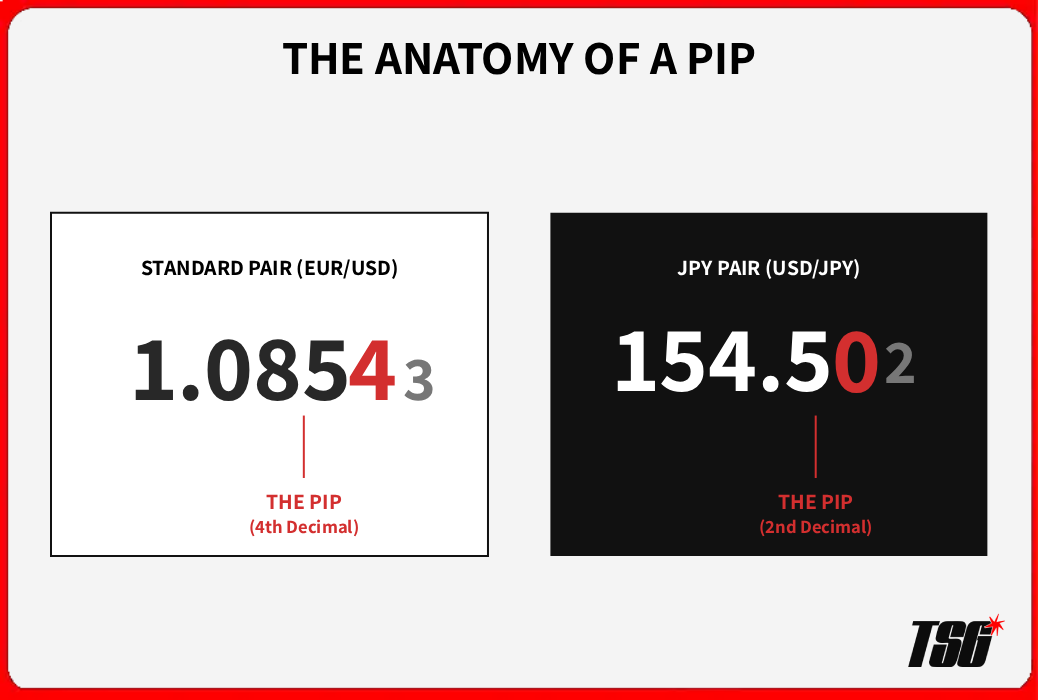
Figure 1 — Pip anatomy for EUR/USD and USD/JPY. For most pairs, the pip is the fourth decimal place (0.0001). For JPY pairs, the convention is different — the pip is the second decimal place (0.01). This is the most common source of confusion for beginners.
The Fourth Decimal Place Rule (and the JPY Exception)
For the vast majority of currency pairs—including EUR/USD, GBP/USD, AUD/USD, USD/CHF, and most others—the pip is the fourth decimal place, representing a price change of 0.0001.
The JPY exception: All currency pairs that include the Japanese yen as the quote currency—such as USD/JPY, EUR/JPY, GBP/JPY, and others—display only two decimal places. This is because the yen’s exchange rate is much higher in absolute terms (USD/JPY trades around 150, not 1.50). For these pairs, the pip is the second decimal place, representing a price change of 0.01.
Forgetting this exception is one of the most common and costly mistakes forex beginners make. If you calculate pip values for USD/JPY using the four-decimal rule, your position sizing will be completely wrong, and you will take on ten times more or less risk than you intended.
|
Pipettes: The Fifth Decimal Place
Pipettes (also called fractional pips or points) are the fifth decimal place for standard pairs, and the third decimal place for JPY pairs. Most modern forex brokers now quote prices to five decimal places—for example, EUR/USD at 1.08543 rather than 1.0854.
The extra decimal gives brokers greater precision in their pricing and allows for tighter spreads. A pipette is one-tenth of a pip. When a broker quotes EUR/USD at 1.08543, the ‘3’ is the pipette. For your trading calculations, you can generally round to four decimal places unless you are trading very large sizes, where the difference matters.
3.2
How to Calculate Pips Value
This is where most beginners get stuck—and where most pip articles let them down by skipping the math. The pip value is the dollar amount that one pip of movement represents for your position size. Knowing this number before you enter a trade is not optional: it is how you calculate your risk, set your position size, and understand exactly what is at stake.
The pip value depends on two things: the lot size you are trading and the currency pair. Let us work through both cases.
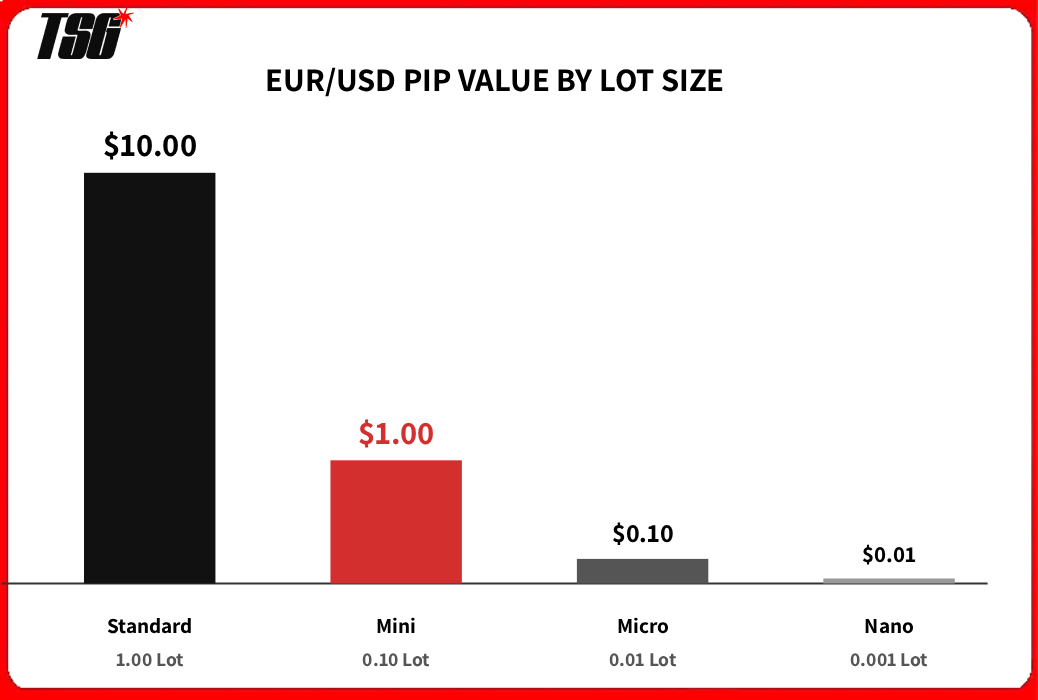
Figure 2 — Pip values for EUR/USD by lot size. The differences are dramatic: a standard lot produces $10.00 per pip while a micro lot produces just $0.10. This is why choosing the right lot size is so critical to risk management.
Pips Value for USD-Quoted Pairs
When the US dollar is the quote currency (the second currency in the pair)—as with EUR/USD, GBP/USD, AUD/USD, and NZD/USD—the pip value calculation is straightforward:
Pip Value = Lot Size × Pip Size (0.0001)
- For a standard lot (100,000 units) on EUR/USD: 100,000 × 0.0001 = $10.00 per pip.
- For a mini lot (10,000 units) on GBP/USD: 10,000 × 0.0001 = $1.00 per pip.
- For a micro lot (1,000 units) on AUD/USD: 1,000 × 0.0001 = $0.10 per pip.
Because the quote currency is already USD, the pip value is directly expressed in dollars—no additional conversion is needed. This is the simplest case.
Pips Value for Non-USD Quote Currencies
When the quote currency is not the US dollar—as with USD/JPY (quote currency = JPY), EUR/GBP (quote currency = GBP), or USD/CHF (quote currency = CHF)—one additional step is required: converting the pip value from the quote currency into US dollars.
Pip Value (USD) = (Lot Size × Pip Size) ÷ Current Exchange Rate
Example: USD/JPY at 154.50, one standard lot (100,000 units), pip size = 0.01:
- Pip value in JPY = 100,000 × 0.01 = ¥1,000
- Pip value in USD = ¥1,000 ÷ 154.50 = $6.47 per pip
This is why pip values on JPY pairs fluctuate as the exchange rate changes—and why simply multiplying lot size by pip size gives you an incomplete answer for any pair where the quote currency is not the US dollar.
|
3.3
Forex Lot Sizes: Standard, Mini, Micro, and Nano
A lot is the standardized unit of measurement for position size in forex trading. Rather than saying ‘I want to buy 10,000 euros’, you say ‘I want to buy one mini lot of EUR/USD.’ Understanding lot sizes is essential because they directly determine the dollar value of each pip—and therefore the dollar value of your risk on any given trade.
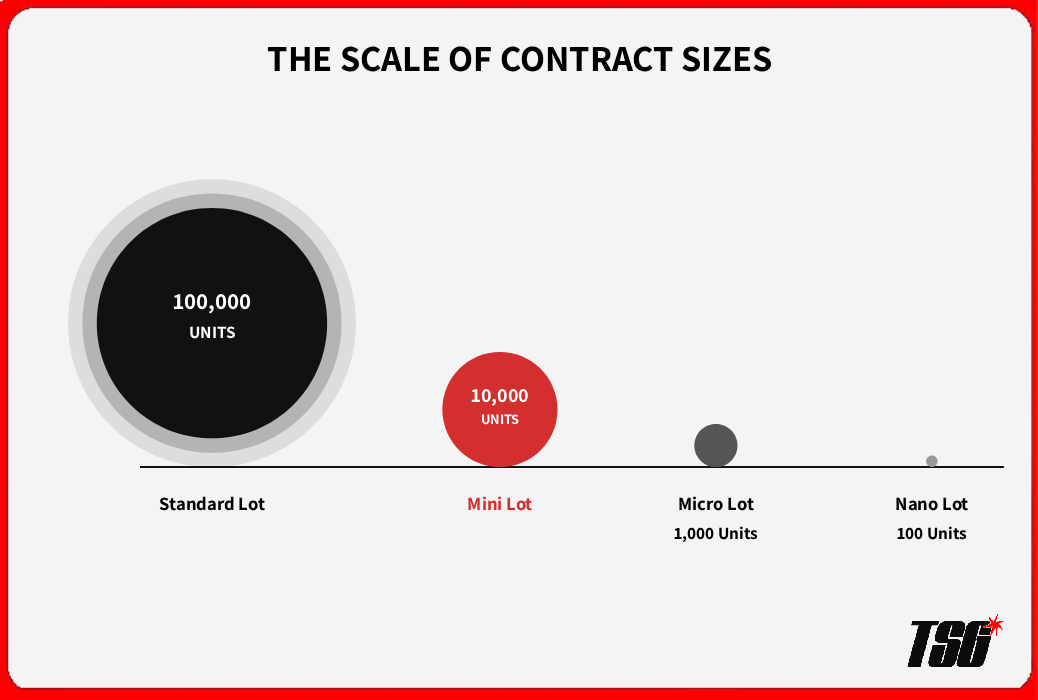
Figure 3 — The four lot sizes and their relative scale. A standard lot is 1,000 times larger than a nano lot. For most beginners, micro lots are the most appropriate starting point — they allow real trading with meaningful but manageable position sizes.
Which Lot Size Should Beginners Use?
For most beginners starting with a live account of $500–$2,000, micro lots are the appropriate starting point. They allow you to experience the emotional reality of trading real money while keeping the absolute dollar risk at a manageable level.
Here is why this matters: if you trade one micro lot on EUR/USD with a 50-pip stop-loss, your maximum risk is 50 × $0.10 = $5.00. That is a meaningful but not catastrophic amount — enough to feel the psychological reality of a real loss without threatening your account.
Risk Management: Forex Lot Sizing & Exposure Metrics
| Lot Type | Contract Size | EUR/USD Pip Value | Recommended For |
|---|---|---|---|
| Standard Lot | 100,000 units | $10.00 per pip | Experienced traders, $10,000+ accounts |
| Mini Lot | 10,000 units | $1.00 per pip | Intermediate traders, $1,000–$10,000 |
| Micro Lot | 1,000 units | $0.10 per pip | Beginners, accounts under $2,000 |
| Nano Lot | 100 units | $0.01 per pip | Very small accounts, learning phase |
If you made the mistake of trading one standard lot with the same 50-pip stop-loss, your risk would be 50 × $10.00 = $500 — potentially 25–50% of a small starter account on a single trade. This is exactly how beginner forex accounts get destroyed in days rather than weeks.
|
3.4
The Bid-Ask Spread: Your First Trading Cost
Every time you open a forex trade, you pay a cost immediately—before the market moves a single pip. This cost is the bid-ask spread: the difference between the price at which the market will buy from you (the bid) and the price at which it will sell to you (the ask).
The ask is always slightly higher than the bid. When you buy, you pay the higher ask price. When you sell, you receive the lower bid price. The difference between the two—measured in pips—is the spread. It is the primary revenue source for forex brokers and your primary ongoing cost of trading.
Example: EUR/USD is quoted at Bid: 1.08480 / Ask: 1.08520. The spread is 0.00040 = 4 pips. The moment you buy at 1.08520, the market’s bid for your position is 1.08480—so you are immediately showing a floating loss of 4 pips. The market must move 4 pips in your favor just to get back to breakeven.
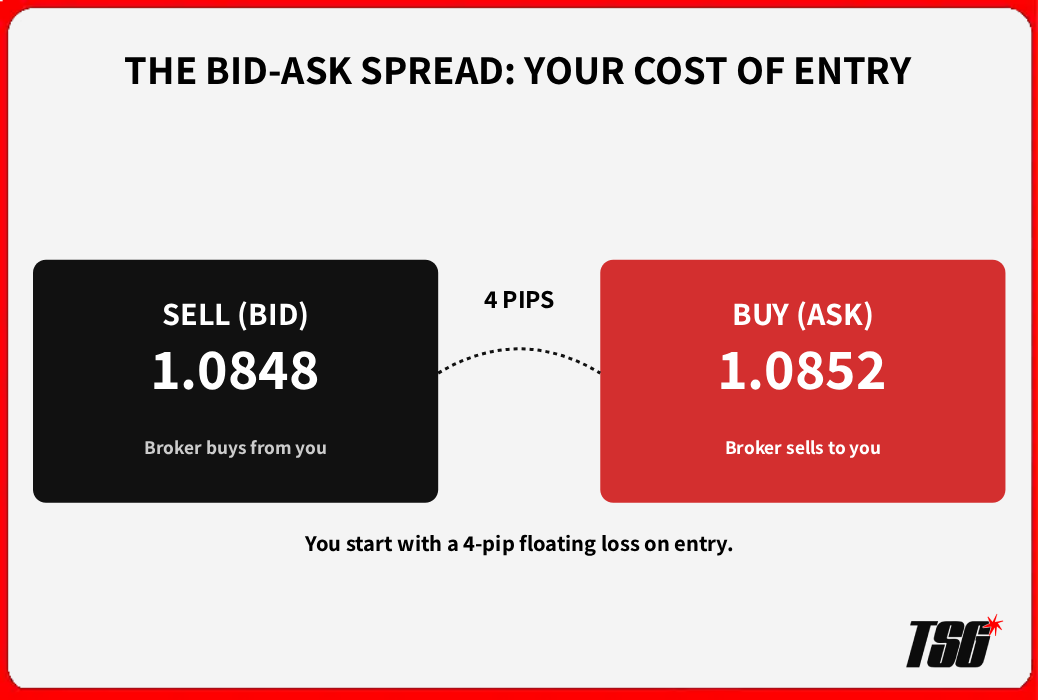
Figure 4 — Left: EUR/USD variable spread over 24 hours. Spreads are tightest during the London-New York overlap (13:00–17:00 UTC) and widen dramatically during off-hours. Right: how the spread creates an immediate floating loss on trade entry and must be overcome before profit begins.
Fixed vs Variable Spreads
Fixed spreads remain constant regardless of market conditions—a 2-pip spread on EUR/USD stays at 2 pips whether you trade at 9 am London or 2 am Tokyo. These are typically offered by market maker brokers. The advantage is predictability; the disadvantage is that the fixed spread may be higher than variable spreads during active trading hours.
Variable spreads fluctuate with market conditions—typically much tighter during active, liquid sessions (sometimes as low as 0.1–0.5 pips on EUR/USD with an ECN broker) and significantly wider during off-hours, major news events, or periods of low liquidity. These are offered by ECN and STP brokers. The advantage is lower costs during optimal conditions; the disadvantage is unpredictable costs during volatile periods.
|
How the Spread Affects Your Profit Target
Understanding the spread’s impact on your profit target is critical for setting realistic trade expectations. If your technical analysis identifies a 30-pip profit target but your broker charges a 3-pip spread, your actual net profit is only 27 pips—a 10% reduction in your expected return before the market has moved at all.
The practical implication is that your profit target must be sufficiently wide to cover the spread and still deliver a meaningful reward. On a trade with a 10-pip profit target and a 3-pip spread, you need the market to move 13 pips from your entry (3 pips to cover the spread, plus 10 pips of actual movement) just to reach your target. This makes very short-term scalping strategies with small profit targets extremely difficult to make consistently profitable—the spread eats too much of the expected return.
|
3.5
Putting It Together: Calculating P&L Step by Step
Now that you understand pips, lot sizes, and spreads individually, let us put all three together in two complete, realistic trade examples. The ability to perform this calculation—or estimate it quickly in your head—before placing any order is one of the most important practical skills in forex trading.
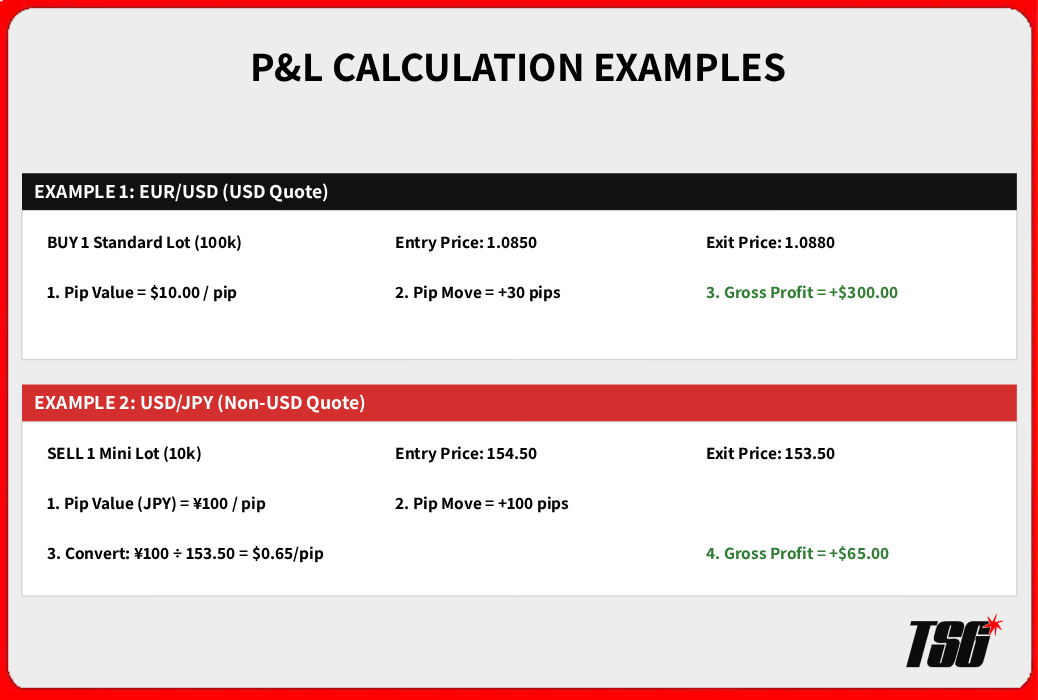
Figure 5 — Two complete P&L walkthroughs: a EUR/USD long trade on a standard lot (top) and a USD/JPY short trade on a mini lot (bottom). Work through both examples until the calculation feels natural before placing any live trade.
The key takeaways from these two examples:
- The spread is paid on entry, not exit. Your floating loss immediately after opening equals the spread × pip value. The market must move past your break-even (entry + spread) before you begin generating profit.
- JPY pip values are not fixed. Because the yen trades at much higher absolute price levels, pip values for JPY pairs fluctuate with exchange rate movements. Always recalculate or use a calculator rather than memorizing a fixed value.
- Net profit is always less than gross pip profit. The spread is the minimum deduction. If your broker also charges a commission (common with ECN accounts), that is an additional cost on both entry and exit.
|
3.6
Frequently Asked Questions
Q: What is the pip value for GBP/USD?
GBP/USD uses the same formula as EUR/USD because the USD is the quote currency. The pip value is: lot size × 0.0001. A standard lot breaks down to 100,000 × 0.0001 = $10.00 per pip. Meanwhile, a mini lot yields $1.00 per pip. Finally, trading a micro lot equals $0.10 per pip. The values are identical to EUR/USD because in both cases, you are simply calculating 0.0001 of a USD-denominated position.
Q: Does the pip value change as the price of a currency pair moves?
When the USD acts as the quote currency (EUR/USD, GBP/USD, AUD/USD), the pip value remains fixed regardless of the price level. Conversely, if the USD is the base currency (USD/JPY, USD/CHF, USD/CAD), or neither currency is the USD (EUR/GBP, EUR/JPY), the dollar pip value changes as the exchange rate moves. This is why JPY pairs require recalculation or a calculator—a USD/JPY trade at 140 has a different pip value than the same lot size at 155.
Q: What spread should I expect on major currency pairs?
On major currency pairs like EUR/USD and USD/JPY during the London-New York overlap, competitive ECN brokers offer spreads as low as 0.1–0.5 pips (though they typically add a commission per lot). Market maker brokers typically offer fixed spreads of 1–3 pips on major currency pairs. During off-hours or major news events, even ECN variable spreads can widen to 5–20 pips. Always check your broker’s typical and maximum spreads for the pairs you intend to trade.
Q: How many pips do I need to make $100 on a mini lot?
On EUR/USD with one mini lot, each pip is worth $1.00. To make $100, you need to capture 100 pips—after accounting for the spread. If the spread is 1.5 pips, you actually need the market to move 101.5 pips from your entry price to net $100. On GBP/USD (also $1.00 per pip on a mini lot), the same calculation applies. On USD/JPY (approximately $0.65 per pip on a mini lot), you would need approximately 154 pips to net $100.
Q: Can I trade forex without understanding pip calculations?
Technically, yes—but practically no. Without understanding pip values and lot sizes, you cannot calculate your position size correctly, which means you cannot control your risk per trade. This is the primary reason beginners destroy their forex accounts so quickly—they size their trades by intuition or by what feels like a reasonable amount, rather than using a precise calculation that limits risk to 1–2% of their capital. The pip calculation is not optional knowledge; it is the foundation of every risk management decision you will ever make.
3.7
Quiz
Check your understanding of the key concepts covered in this article. Read each question carefully, select your answer, then check the explanation below.
→ Continue Reading
You can now calculate pip values and lot sizes. Next, understand leverage — the most powerful and dangerous tool in forex: Leverage and Margin in Forex Explained.