
2.1
What Is a Currency Pair?
A currency pair is a quotation of two currencies expressed as a ratio. It tells you how much of the second currency (the quote currency) is required to buy one unit of the first currency (the base currency). Every forex transaction involves buying one currency and simultaneously selling another—the pair defines which two currencies are involved.
Currency pairs are always written in a standardized format: BASE/QUOTE. EUR/USD, for example, represents the euro (base) against the US dollar (quote). GBP/JPY represents the British pound (base) against the Japanese yen (quote).
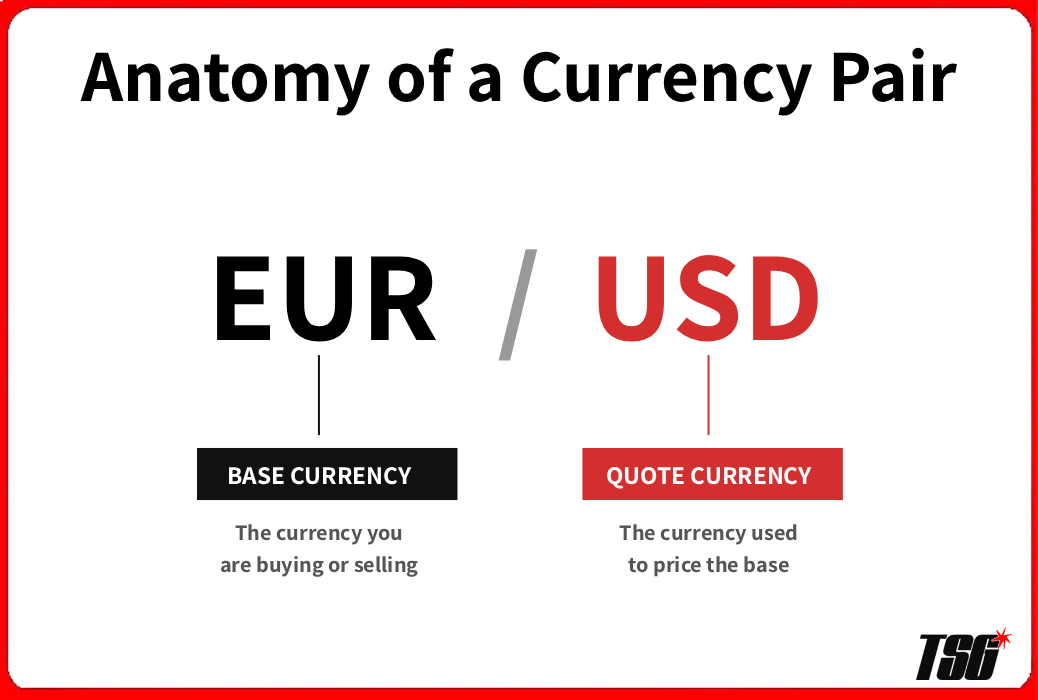
Figure 1 — The anatomy of a currency pair: EUR/USD at 1.0854 means 1 euro costs 1.0854 US dollars. The base currency is what you are buying or selling; the quote currency is the pricing currency. Understanding this relationship is essential before placing any trade.
Base Currency vs Quote Currency
The base currency is the first currency in the pair—the currency you are buying or selling. When you go long (buy) EUR/USD, you are buying euros. When you go short (sell) EUR/USD, you are selling euros.
The quote currency is the second currency in the pair—it is the currency used to price the base currency. In EUR/USD, the US dollar is the quote currency. The exchange rate tells you how many dollars one euro costs.
If EUR/USD rises from 1.0800 to 1.0900, it means the euro has strengthened against the dollar—one euro now buys more dollars than before. Conversely, should it fall from 1.0800 to 1.0700, the euro has weakened—it now buys fewer dollars. This logic applies to every currency pair: when the pair’s price rises, the base currency is strengthening; when it falls, the base is weakening.
How to Read a Currency Quote
A forex quote always shows two prices: the bid (the price at which the market will buy from you) and the ask (the price at which the market will sell to you). These are always shown as Bid / Ask—for example, EUR/USD 1.0848 / 1.0852.
When you want to buy EUR/USD, you pay the ask (1.0852—the higher price). When you want to sell, you receive the bid (1.0848—the lower price). The difference between the two—0.0004 or 4 pips—is the spread, which is your cost of entering the trade. This concept is covered in full depth in Article 3 of this module.
|
2.2
Major Currency Pairs: The Most Traded in the World
Major currency pairs are defined as the seven most heavily traded currency pairs in the world—all of which include the US dollar as either the base or the quote currency. The US dollar is involved in approximately 88% of all forex transactions globally, making it the world’s reserve currency and the universal pricing benchmark for international trade and finance.
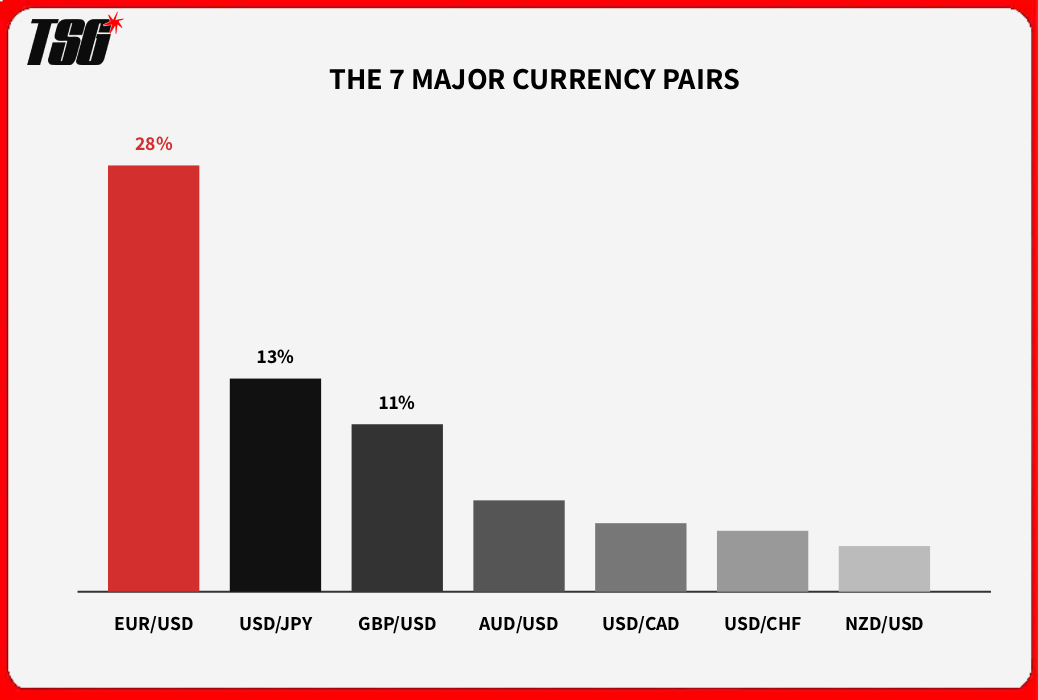
Figure 2 — The seven major currency pairs: their share of daily volume, typical spreads, and key trading characteristics. EUR/USD alone accounts for nearly 28% of all global forex volume — more than the next two pairs combined.
EUR/USD — The World’s Most Traded Pair
EUR/USD is the flagship of the forex market. It represents the two largest economic blocs in the world—the eurozone and the United States—and accounts for approximately 28% of all daily forex trading volume. No other currency pair comes close.
The practical implications of this dominance are significant for traders. EUR/USD has the tightest spreads of any pair (often under 0.5 pips with ECN brokers during peak hours), the deepest liquidity, and the most predictable technical behavior. It responds clearly to the policy decisions of the two most-watched central banks in the world—the Federal Reserve and the European Central Bank.
For beginners, EUR/USD is the optimal starting pair. Its liquidity means your orders are filled instantly at virtually the price you see on screen. Its sensitivity to well-known macro drivers means the fundamental narrative is always relatively clear, and its smooth, technical price behavior means chart patterns and indicator signals work more reliably than on most other pairs.
GBP/USD, USD/JPY, USD/CHF, AUD/USD, USD/CAD, NZD/USD
The remaining six major pairs each have distinct personalities and market drivers that experienced traders learn to use as an edge:
- GBP/USD (‘Cable’): The second most volatile of the major pairs. UK political risk, Brexit aftermath, and Bank of England decisions create sharp, high-momentum moves. Best for experienced price action traders; can be unpredictable for beginners.
- USD/JPY: Driven primarily by US Treasury yields and risk sentiment. When investors are fearful, they buy yen (risk-off). When confident, they sell yen (risk-on). Clear, logical behavior that rewards macro-aware traders.
- USD/CHF: The Swiss franc is a traditional safe haven—it strengthens during geopolitical crises and uncertainty. The Swiss National Bank (SNB) is known for surprising the market with sudden interventions, which creates occasional extreme volatility.
- AUD/USD (‘Aussie’): A commodity currency—the AUD is strongly correlated with gold and iron ore prices. China’s economic health is also a major driver, as Australia’s largest trading partner. Useful for traders interested in commodity market connections.
- USD/CAD (‘Loonie’): Oil-correlated pair. When crude oil prices rise, CAD typically strengthens (and USD/CAD falls). Bank of Canada decisions and Canadian employment data provide regular trading catalysts.
- NZD/USD (‘Kiwi’): The smallest of the seven majors by volume. Follows commodity prices and risk sentiment similarly to AUD/USD. The two pairs often move together, which has implications for portfolio correlation that beginners should understand before trading both simultaneously.
2.3
Minor (Cross) Currency Pairs
Minor currency pairs—also called ‘cross currency pairs’ or simply ‘crosses’—are pairs that include two major currencies but do not include the US dollar. Examples include EUR/GBP, EUR/JPY, GBP/JPY, AUD/JPY, EUR/AUD, and GBP/CHF.
Market Execution: Major Cross Pairs & Volatility Drivers
| Cross Pair | Currencies | Typical Spread | Key Driver |
|---|---|---|---|
| EUR/GBP | Euro / British Pound | 1.0–1.5 pips | UK vs EU economic divergence; BoE vs ECB policy |
| EUR/JPY | Euro / Japanese Yen | 1.2–1.8 pips | Risk sentiment: ECB vs BOJ policy divergence |
| GBP/JPY | British Pound / Japanese Yen | 1.5–2.5 pips | High volatility; combines UK and JPY dynamics |
| AUD/JPY | Australian Dollar / Yen | 1.5–2.2 pips | Best risk-on/risk-off barometer in forex |
| EUR/AUD | Euro / Australian Dollar | 1.8–2.5 pips | Commodity prices vs European economic data |
| GBP/CHF | British Pound / Swiss Franc | 2.0–3.0 pips | UK risk vs CHF safe-haven demand |
Crosses exist because not every international trade or investment flows through the US dollar as an intermediary. A European company doing business in Japan does not need to convert euros to dollars and then dollars to yen—it can transact directly in EUR/JPY. The forex market accommodates this with direct cross-currency quotations.
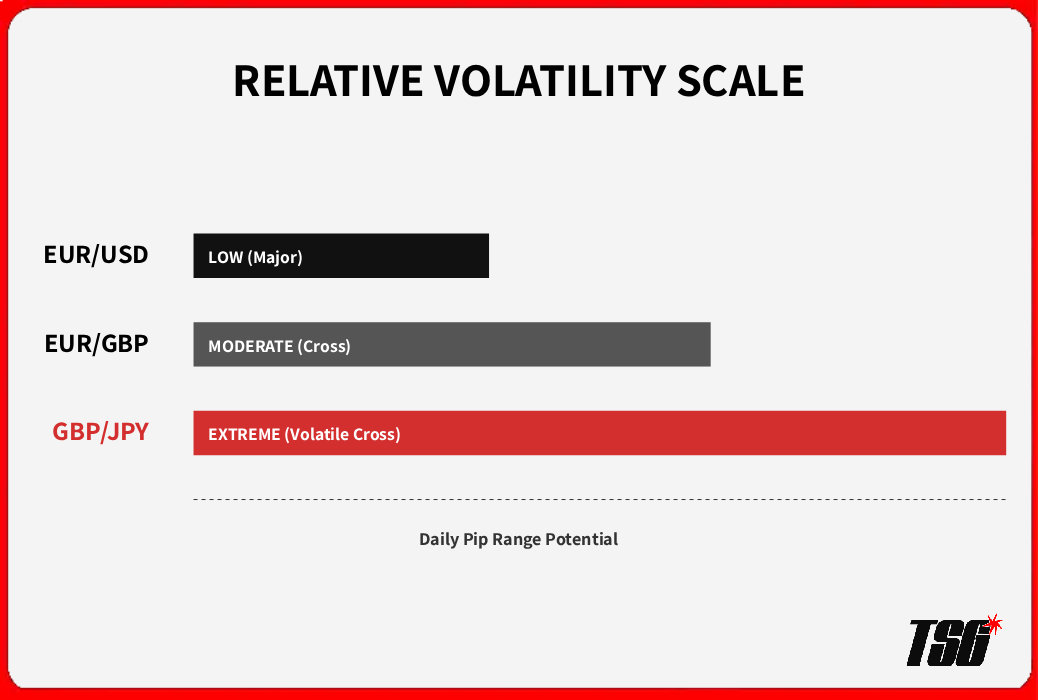
Figure 3 — Volatility comparison over 30 days: EUR/USD (most stable), EUR/GBP and EUR/JPY (moderate), and GBP/JPY (extreme). GBP/JPY combines the volatility of two separately volatile currencies, making it unsuitable for beginners regardless of its attractive chart patterns.
Why Crosses Can Be More Volatile
Minor pairs are generally more volatile than the major pairs because they inherit the price sensitivity of both constituent currencies simultaneously. GBP/JPY, for example, absorbs UK economic events (which move GBP) and Japanese monetary policy events (which move JPY)—it is exposed to catalysts that move each currency in different directions, sometimes within minutes of each other.
Additionally, crosses have lower liquidity than major pairs—particularly at certain times of day—which means spreads widen more significantly during off-hours and around news events. This higher spread cost, combined with higher volatility, means that crossing pairs offer wider potential gains but also wider potential losses. This is a trade-off beginners are rarely equipped to manage consistently.
2.4
Exotic Currency Pairs: High Risk, High Cost
Exotic currency pairs consist of one major currency (typically USD, EUR, or GBP) paired with the currency of an emerging market or smaller developed economy—such as the Mexican peso (MXN), Turkish lira (TRY), South African rand (ZAR), Thai baht (THB), or Singapore dollar (SGD).
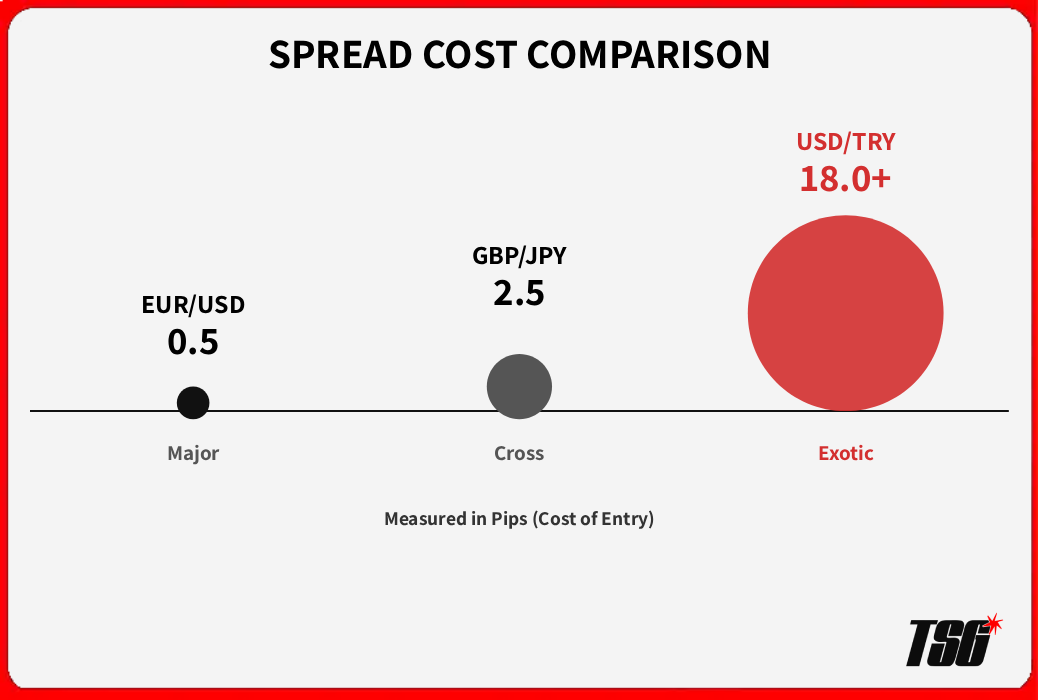
Figure 4 — Spread comparison across major, minor, and exotic pairs. While EUR/USD trades at 0.5 pips, USD/ZAR can cost 12+ pips, and USD/TRY can exceed 18 pips. On a standard lot ($10 per pip), a single USD/TRY trade costs $180 in spread alone before the market moves one pip.
Examples and Why Beginners Should Avoid Them
Exotic pairs are characterized by three features that make them genuinely unsuitable for beginner traders: extremely wide spreads, low liquidity, and political risk.
- Wide Spreads: While EUR/USD costs 0.5 pips per trade, USD/TRY can cost 18+ pips. On a mini lot ($1 per pip), that is $18 just to enter the trade. Your target must be large enough to overcome this cost, which immediately eliminates many of the short- and medium-term strategies suitable for beginners.
- Low Liquidity: Emerging market currencies can become extremely illiquid during periods of global stress. During the March 2020 COVID selloff, many exotic pairs had spreads ten times their normal width—making it impossible to exit positions at reasonable prices precisely when you most needed to.
- Political and Economic Instability: Emerging market currencies are vulnerable to sudden, extreme moves driven by political crises, sovereign debt concerns, inflation spiraling out of control, and government intervention. The Turkish lira has lost over 80% of its value against the dollar in five years—a move that would have destroyed any unleveraged long position and instantaneously blown out leveraged accounts.
|
2.5
Which Currency Pairs Should Beginners Trade?
The single most important pair selection decision you will make as a beginner is the simplest one: start with EUR/USD and nothing else.
This recommendation is not arbitrary. EUR/USD has the tightest spreads, the deepest liquidity, the smoothest technical behavior, and the clearest macro narrative of any pair in the market. It rewards the application of every skill covered in this course—technical analysis, fundamental analysis, risk management—more reliably than any other pair. Learning on EUR/USD means that when you eventually add other pairs, you already have a solid comparative baseline.
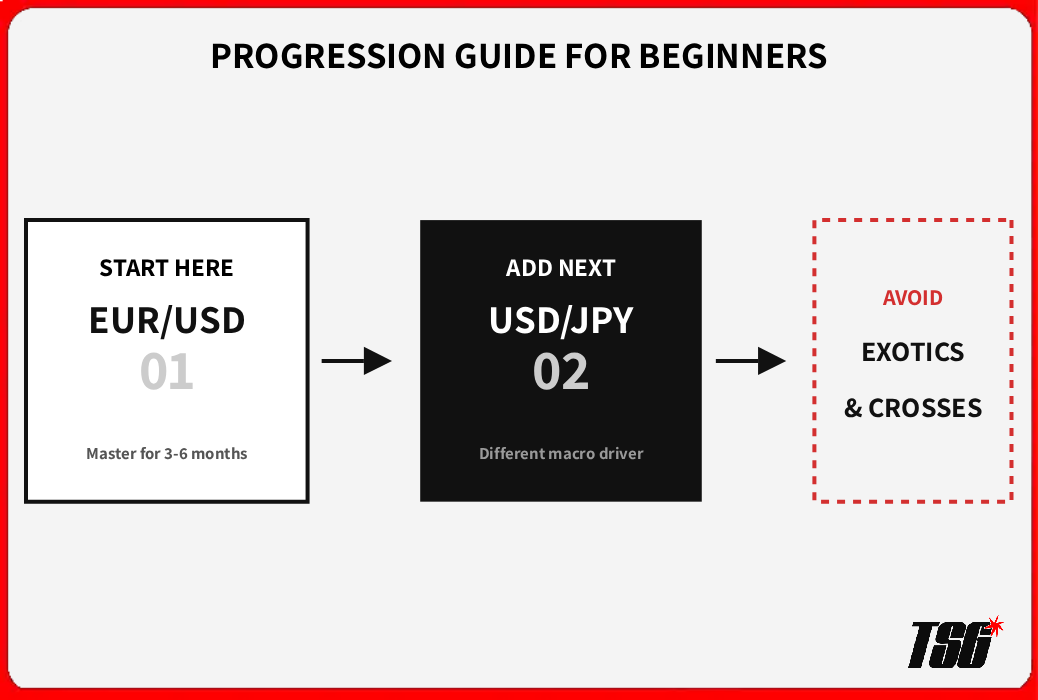
Figure 5 — Beginner pair selection guide: start with EUR/USD and USD/JPY, add GBP/USD and AUD/USD after 3–6 months, and avoid GBP/JPY and all exotics until you have extensive experience. The temptation to trade more volatile pairs is normal — but it consistently costs beginners more than it rewards them.
After three to six months of consistent EUR/USD trading—with a documented record in your trading journal—you can sensibly add USD/JPY. Its distinctly different macro drivers (US yields, risk sentiment, Bank of Japan policy) teach you a second analytical framework without dramatically increasing the complexity of your execution. From there, you can add GBP/USD and AUD/USD as you gain confidence.
|
2.6
Quiz
Check your understanding of the key concepts covered in this article. Read each question carefully, select your answer, then check the explanation below.
→ Continue Reading
You know the pairs — now learn the price language of forex: Pips, Lots and Spreads Explained.