Risk Warning: Trading in CFDs, involves a high level of risk. 77.95% of retail investor accounts lose money when trading CFDs with this provider. It is possible to lose all your invested capital. Such financial products may not be suitable or allowed for you, and you should consider such restrictions and whether you understand how CFDs work and all the risks involved.

Buffett: The Making of an American Capitalist
Roger Lowenstein
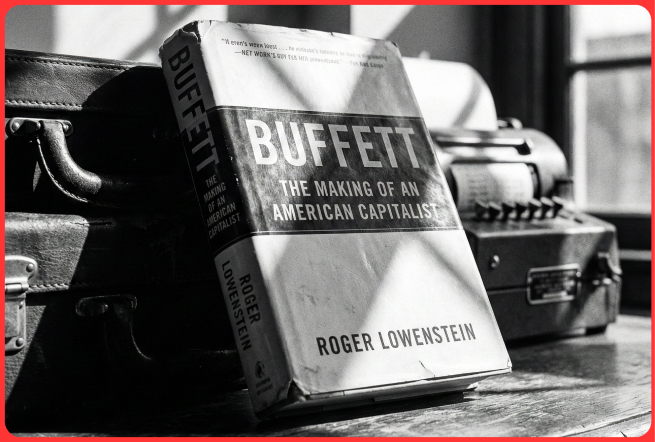
Table of Contents
Buffett: The Making of an American Capitalist, written by Roger Lowenstein, is more than a story about one man becoming rich. It is a study of how meaningful wealth can be built from scratch through discipline, patience, and clear thinking while the rest of the world chases trends and headlines. Lowenstein’s biography follows Buffett from a boy in Omaha counting coins to a careful steward of capital whose habits, not secrets, explain his success.
The book brings Buffett down from myth to human scale. It shows a child obsessed with numbers, a young man searching for guidance, and an adult shaped by teachers, partners, and setbacks. Through these stages, the reader sees that Buffett’s edge comes not from genius alone but from routines and principles anyone can practice over a lifetime.
How the Biography Changes the Image of Buffett
Lowenstein’s portrait replaces the distant legend with a persistent problem‑solver who starts small, fails, and adjusts. Early scenes—like the boy with a black bag of nickels or the teenager mapping paper routes—reveal a mind drawn to order, accumulation, and long‑term thinking, long before large sums were involved.
By slowing down at these details, the book makes Buffett’s life feel less like destiny and more like a series of choices. The emphasis on family tensions, daily habits, and quiet calculations shows that discipline is built in ordinary moments, not just at turning points.
Family Values and First Lessons
Buffett’s childhood in Omaha laid the foundation for his later approach to money and responsibility. His father’s brokerage office, filled with paper, ink, and the unease of shifting markets, introduced Warren to the world of tickers, quotes, and business chatter. Those cryptic numbers fascinated him, planting an early curiosity about patterns of risk and reward.
At home, the atmosphere mixed ethics, politics, and finance. Conversations around the dinner table forced Warren to pay attention, listen, and form opinions. The young Buffett learned that markets did not exist in isolation; they were tied to human behavior, belief, and public life.
Howard Buffett’s Influence
Howard Buffett, Warren’s father, was more than a stockbroker. He modeled honesty, independence, and a deep suspicion of shortcuts, often without formal lectures. His entry into Congress exposed Warren to questions of public duty and private interest, reinforcing the idea that financial decisions have moral weight.
This blend of brokerage work and political service gave Warren an unusual lens. He saw that trust could be easily broken and that reputations were fragile. Lowenstein suggests that these early impressions helped shape Buffett’s later insistence on integrity in both personal conduct and business relationships.
Leila Buffett’s Demands and Discipline
Warren’s mother, Leila, brought a different kind of pressure. She expected neat work, controlled behavior, and serious attention to obligations. Her sharp comments about his habits and ambitions created tension, but they also pushed him to refine his methods and accept criticism.
The biography shows that this strict environment was uncomfortable but useful. Leila’s high standards helped sharpen Warren’s focus and made him more methodical. Over time, her insistence on order echoed in his later approach to analysis, record‑keeping, and decision‑making.
Small Ventures as Early Training
Buffett’s first ventures—selling gum, soda, and other small goods door‑to‑door—were modest but essential. He counted every sale, tracked his earnings, and compared outcomes across different experiments. Each failure or slow day became information rather than a source of shame.
Lowenstein presents these routines as a prototype of Buffett’s later process. The habit of trying, measuring, adjusting, and trying again formed a pattern he would later apply to stocks and businesses. The message is clear: meaningful success grows from many small, observed steps rather than a single breakthrough.
First Steps Beyond the Family—Education and Mentorship
As Buffett grew older, his curiosity turned into a hunger for structured knowledge. He devoured books on business, markets, and famous financiers, often spending long hours alone with reports and biographies while others socialized. These early reading habits made studying feel less like an obligation and more like a path to independence.
School was not just a place for grades; it was a laboratory. Buffett tested ideas from his reading against real businesses around him, always asking how companies made money and why some survived while others failed. This blend of theory and observation prepared him for bigger decisions to come.
Seeking the Right Classroom
Buffett’s time at the Wharton School was a necessary detour. The institution was prestigious, but the experience did not fully match his expectations. Lectures often felt distant from the practical questions that interested him most, and he sensed that many classmates were chasing status rather than understanding.
His transfer to the University of Nebraska showed an early willingness to break from convention. There, he balanced coursework with running small businesses, proving that study and enterprise could reinforce each other. Lowenstein presents this shift as a first sign that Buffett would prioritize fit and substance over reputation and fashion.
Discovering Benjamin Graham
The turning point came when Buffett encountered Benjamin Graham’s writing. The Intelligent Investor and other works landed with the force of revelation, offering a clear philosophy: focus on intrinsic value, demand a margin of safety, and treat stocks as ownership stakes, not trading chips.
Buffett did more than agree with Graham; he reorganized his thinking around these principles. He tracked prices against underlying value and began to see the market as a place where patience and analysis could exploit temporary mispricing. This shift laid the conceptual foundation for everything that followed.
Learning Directly from a Master
Determined to learn from Graham in person, Buffett enrolled at Columbia Business School, where Graham taught. In that classroom, surrounded by aspiring analysts, he found an intellectual home built on skepticism, discipline, and evidence. Case studies, balance sheets, and probing questions replaced vague theories.
Graham’s quiet but demanding style left a deep mark. Lowenstein shows how Buffett absorbed not only methods, but also attitude: question assumptions, rely on data, and resist emotional swings. The relationship proved formative, shaping Buffett’s early investment partnerships and remaining a reference point even as his own style later evolved.
Early Businesses and the Search for Identity
After Columbia, Buffett returned to Omaha carrying Graham’s framework and a strong desire to apply it. His first steps were not glamorous. Working at his father’s brokerage, he was expected to cold‑call clients and sell stocks, a role that clashed with his preference for quiet analysis over persuasion.
This period forced Buffett to confront a key question: was he a salesman or an investor? The discomfort he felt pushing ideas he did not fully believe in sharpened his sense of ethics and his resolve to base recommendations on solid conviction, not pressure.
Testing Principles with His Own Money
Buffett began investing small amounts of his own savings, applying Graham’s margin‑of‑safety approach. He scrutinized annual reports, compared market prices to conservative estimates of value, and favored companies where assets or earnings more than justified the stock price.
Losses in this phase were treated as lessons. Lowenstein emphasizes how Buffett recorded outcomes, reviewed mistakes, and refined his filters rather than blaming luck. Each trade became an experiment: an opportunity to test whether his reasoning held up in real conditions.
Launching the First Partnerships
Realizing that managing capital for others would let him focus on analysis instead of sales, Buffett formed his first investment partnerships with family and close friends. The terms were strict and straightforward: he would take a share of profits only if returns beat a set benchmark, and he pledged complete transparency about results.
This structure aligned his incentives with his partners and reinforced his preference for long‑term thinking. Regular letters and meetings kept investors informed, with no attempt to hide volatility or dress up disappointing periods. From the start, trust and clarity were central to his identity as a manager.
Responsibility as a Teacher
Managing other people’s money changed the weight of each decision. Gains brought satisfaction, but errors carried the burden of affecting others’ savings and futures. Lowenstein shows how this responsibility deepened Buffett’s discipline: he dug further into numbers, hesitated before speculative ideas, and maintained detailed records of every move.
These early years did not make him rich overnight. Instead, they hardened his process and clarified his role. Buffett was learning that his edge lay not in charisma or prediction, but in careful judgment, ethical conduct, and the willingness to explain his reasoning plainly—even when it invited criticism.
Turning Partnerships into Progress
As capital in Buffett’s partnerships grew, the structure he had created was tested by real‑world swings in markets and sentiment. The partnerships remained small compared to Wall Street firms, but they carried high expectations from relatives and friends who trusted him with their savings. Buffett responded not with grand promises, but with a steady emphasis on process, caution, and patience.
Monthly and annual reports spelled out performance in plain language. Partners saw both gains and setbacks clearly laid out, along with Buffett’s reasoning for major positions. This openness reinforced confidence and allowed the group to endure the inevitable stretches when results lagged or opportunities were scarce.
A Clear Contract with Investors
Buffett’s compensation terms reflected his belief in fairness and alignment with his interests. He earned a share of profits only after a minimum return was achieved, and nothing at all if results fell short of that threshold. This structure signaled that he stood alongside his partners, not above them, sharing the same risks and rewards.
Lowenstein notes that this approach built loyalty over time. Even in complex markets, partners knew that Buffett did not benefit from activity alone; he was rewarded only when careful analysis led to strong outperformance. This discouraged unnecessary trading and reinforced his preference for meaningful, high‑conviction ideas.
Learning to Communicate Through Volatility
Markets delivered both sharp advances and abrupt declines during the partnership years, and each cycle tested nerves. Buffett used letters and meetings to explain why some holdings fell short, why others remained attractive, and why inaction could be wiser than rapid change.
He treated his partners as both students and clients, walking them through valuation logic, business quality, and the role of patience. Lowenstein shows how this educational stance helped partners view volatility as part of the process instead of a reason to panic. Over time, this shared understanding became a quiet advantage.
Finding the Edge—Major Investments and Lessons from Risk
With experience and growing capital, Buffett began to pursue more complex and influential investments. These were not speculative leaps but carefully chosen situations where market prices seemed profoundly disconnected from underlying value. Each significant move required not only analysis but also the willingness to act when others hesitated.
Two early examples—Sanborn Map and Dempster Mill—highlight how Buffett combined Graham’s principles with his own evolving style. Both cases involved struggling businesses with assets or potential masked by poor management or neglected operations.
Sanborn Map: Unlocking Hidden Value
Sanborn Map produced detailed city maps used by insurers and businesses, but its operating results had deteriorated. Its investment portfolio, however, was worth more than the company’s stock price. Buffett’s deep study of the balance sheet revealed this gap and convinced him that the market was underestimating the company’s true value.
He accumulated shares and worked with other investors to push for changes that would realize this hidden worth. When the value was finally unlocked, returns were strong. Still, the greater lesson lay in the method: careful reading of financial statements, patience in building a position, and calm activism when necessary.
Dempster Mill: From Investor to Problem‑Solver
Dempster Mill Manufacturing, a maker of windmills and water equipment, presented a different challenge. The company was poorly run, with bloated inventories and weak profits. Here, Buffett’s role extended beyond stock selection into direct involvement with management and operations.
He helped bring in new leadership, pushed for tighter controls, and watched as gradual changes improved performance. This experience showed him that some investments required hands‑on effort and a long horizon. It also reinforced the idea that value investing sometimes meant improving a business rather than just buying it cheaply.
Risk as a Teacher
Lowenstein emphasizes that these ventures were not smooth or risk‑free. Both Sanborn and Dempster came with resistance, setbacks, and long periods of uncertainty. Buffett’s willingness to endure discomfort, backed by evidence and clear logic, distinguished his approach from more impatient investors.
These cases helped refine his judgment about when activism made sense and when it was better to remain a passive owner. They also deepened his respect for capable management—a theme that would grow stronger as his career advanced.
Building Critical Relationships—The Munger Influence and Expanding Horizons
Buffett’s partnership years were marked not only by deals but by relationships that reshaped his thinking. Among these, his connection with Charlie Munger stands out as transformative. Munger shared Buffett’s love of rational inquiry but challenged some of his long‑held assumptions about what constituted a good investment.
Their conversations pushed Buffett beyond a strict, numbers‑only version of value investing. Munger argued that sometimes paying a fair or even slightly higher price for an exceptional business was better than buying a merely cheap company with weak prospects.
Challenging and Refining the Graham Framework
Up to that point, Buffett’s style closely followed Graham’s focus on statistical bargains and undervalued assets. Munger encouraged him to consider factors such as brand strength, durable competitive advantages, and the quality of management. He introduced the idea that a great business could compound value for decades, making the initial price less important than long‑term economics.
Lowenstein shows that Buffett did not immediately accept this view. The shift required him to question comfortable habits and revisit earlier successes through a new lens. Over time, however, he began to blend Graham’s discipline with Munger’s emphasis on quality, creating a more flexible and powerful framework.
Looking for Businesses with Moats
Together, Buffett and Munger started seeking companies with “moats”—structural advantages that protected them from competition. These might include strong brands, cost advantages, or unique products that customers trusted. Such firms could earn high returns on capital for long periods, even in complex markets.
Investments like See’s Candies demonstrated this logic. The company’s loyal customer base and pricing power made it more attractive than many statistically cheap but fragile businesses. Through such examples, Buffett came to appreciate that time and business quality were as important as initial discounts.
Partnership as an Edge
The Buffett–Munger partnership also highlighted the value of honest, demanding dialogue. Both men argued vigorously, questioned each other’s conclusions, and were willing to change their minds when confronted with better reasoning.
Lowenstein suggests that this intellectual partnership played a key role in Buffett’s evolution. It kept his thinking sharp, expanded his opportunity set, and prevented him from becoming rigid as success grew. The lesson extends beyond investing: strong collaborators can challenge and elevate one another in ways solitary work rarely does.
Berkshire Hathaway—Transformation Through Patience and Principle
Buffett’s encounter with Berkshire Hathaway began as a typical value investment and evolved into the central platform of his career. The company was a struggling New England textile mill, weighed down by competition and thin margins, but its assets and cash flow offered what appeared to be a bargain. Buffett bought shares when he believed management had agreed to repurchase stock at a fair price, only to feel misled by a change in terms.
In response, he bought more shares and eventually took control of the company. The early years of ownership were difficult. Buffett tried to improve the textile operation but faced relentless economic headwinds. Lowenstein shows how this period taught Buffett a hard lesson about capital‑intensive, low‑margin businesses, even when they appear cheap on paper.
Shifting from Textiles to a Holding Company
Realizing that textiles could not deliver strong long‑term returns, Buffett began redirecting Berkshire’s capital into other businesses. The decisive step was the purchase of National Indemnity. This insurance company introduced him to the power of “float”—premium dollars held for future claims that could be invested in the meantime.
From there, Berkshire gradually became a holding company, using insurance float and retained earnings to acquire or invest in companies like GEICO, See’s Candies, and The Washington Post. Buffett’s focus shifted from trying to fix a weak core business to building a collection of strong, independently run enterprises.
Culture, Integrity, and Decentralization
Buffett built Berkshire around a simple cultural principle: partner with honest, capable managers and let them run their operations with minimal interference. He favored leaders who treated shareholders like partners and customers with respect, and he offered them autonomy in exchange for transparent reporting and prudent capital use.
Lowenstein emphasizes that this decentralized model depended on trust and alignment. Buffett avoided complex incentive schemes and instead appealed to shared values, long‑term horizons, and reputation. Berkshire’s success reflected not only financial skill but also careful selection of people and cultures that could thrive under this light but demanding touch.
Philosophy in Practice—Risk, Reward, and Humility
As Berkshire grew, Buffett’s investing philosophy became more transparent and more consistent. He focused on businesses he could understand, with predictable earnings, strong competitive positions, and managements he respected. He continued to apply the margin‑of‑safety principle, but now combined it with an appreciation for enduring quality and long compounding periods.
Risk, in Buffett’s view, was not volatility but the chance of permanent loss of capital. Lowenstein shows how this definition guided his refusal to invest in complicated financial products or companies whose economics he could not easily explain.
Discipline in What to Avoid
Buffett’s record is marked as much by what he declined as by what he bought. He stayed away from businesses dependent on unpredictable commodities, highly leveraged structures, or fashions likely to fade. Even when others profited from such areas for a time, he preferred to sit on the sidelines rather than compromise his standards.
This restraint was grounded in humility. Buffett repeatedly acknowledged the limits of his knowledge and refused to let success push him into areas he did not fully grasp. Lowenstein presents this as a key protective factor, helping Berkshire sidestep many crises that damaged more aggressive firms.
Learning from Mistakes in Public
Despite his caution, Buffett made errors and did not hide them. He used annual letters and meetings to dissect decisions that went wrong, explaining what he had misjudged and what he learned. Whether closing a failing unit or exiting a poor acquisition, he faced facts directly rather than blaming markets or subordinates.
This openness reinforced trust and kept ego in check. By treating mistakes as shared lessons, Buffett turned setbacks into tools for collective improvement. The biography makes clear that humility and transparency were not side notes; they were central to how he managed risk over decades.
Public Influence, Reputation, and Lessons for Everyday Investors
Over time, Buffett’s success and communication style drew wide public attention. Annual meetings in Omaha became major events, gathering shareholders, analysts, and admirers who came as much for his explanations as for the numbers themselves. Yet his message to small investors remained consistent and straightforward.
He argued against short‑term speculation and warned about the dangers of leverage and trend‑chasing. Instead, he urged individuals to focus on understandable businesses or broad index funds, to avoid frequent trading, and to let time and compounding do most of the work.
The Power of Plain Communication
Buffett’s shareholder letters became famous for their clarity. He wrote in straightforward language, explained both successes and disappointments, and avoided jargon. Lowenstein highlights how this approach made complex financial matters accessible and built unusual loyalty among investors.
By setting modest expectations and explaining risks clearly, Buffett reduced the temptation for shareholders to overreact to price swings. His communication style served as a stabilizer, aligning behavior with the long‑term philosophy that underlies Berkshire’s strategy.
Reputation as a Core Asset
Throughout the biography, reputation emerges as one of Buffett’s most valued possessions. He repeatedly emphasized that it takes years to build and can be destroyed in moments. This belief shaped how he chose partners, evaluated managers, and responded to ethical challenges.
When potential deals raised concerns about integrity, he walked away, even if the financial terms looked attractive. Lowenstein suggests that this consistency helped attract like-minded people and opportunities, reinforcing a culture in which trust and prudence were central. For everyday investors, the lesson is that character and track record are as important to long‑term success as any numerical metric.
Adapting to Change—Learning from Adversity
Buffett’s story also includes difficult periods that forced adaptation. The decline of Berkshire’s textile operations required him to confront the limits of loyalty to a legacy business and to reallocate capital despite emotional and historical ties.
He made similar adjustments when certain investments underperformed, acknowledging when an industry had changed or when his original thesis no longer held. Lowenstein shows that flexibility, guided by evidence, was a constant companion to Buffett’s long‑term convictions.
Facing Hard Decisions
Closing mills, selling underperforming units, or exiting disappointing positions were never treated lightly. Buffett explained these moves in detail to shareholders, accepting responsibility and outlining what he had learned. This willingness to make and own hard decisions helped Berkshire avoid more serious damage and freed resources for better opportunities.
Adversity became a testing ground for his principles. Rather than abandon his core ideas, he used difficult episodes to refine them—tightening standards for new investments and strengthening his emphasis on business quality and management character.
Constant Learning and Revision
Even in later years, Buffett continued to adjust his approach in response to new information. He expanded into different industries when he felt he could understand them, and he updated his views on topics such as capital allocation and buybacks as conditions changed.
Lowenstein portrays this ongoing learning as a key reason for Buffett’s longevity. He remained anchored by a few core ideas—value, margin of safety, integrity—but allowed methods and applications to evolve. The biography suggests that this balance of stability and flexibility is critical for anyone hoping to navigate long stretches of uncertainty.
Mentoring and Legacy—Teaching the Next Generation
As Buffett’s reputation grew, his role expanded from investor and CEO to mentor and teacher. His annual letters, interviews, and Q&A sessions became informal classrooms where students, professionals, and ordinary savers could study his thinking. He shared not only conclusions but also the reasoning behind them, inviting others to adopt a calmer, more evidence‑based approach to money.
Buffett emphasized simple, repeatable habits: read widely, think independently, avoid debt when possible, and refuse to invest in what you do not understand. Lowenstein presents these not as slogans but as daily practices that shape judgment over time.
Modeling Humility and Admitting Error
Buffett used his public platform to highlight the dangers of overconfidence. He described his own missteps plainly, showing how pride, haste, or neglect of fundamentals had led to losses or missed opportunities. By treating these stories as teaching tools, he encouraged others to view mistakes as data rather than permanent stains.
This openness about failure reinforced his credibility. Investors and readers saw that even with decades of success, Buffett still approached markets with caution and curiosity. The biography underlines that such humility is part of what makes his guidance enduring and relatable.
Passing On Values, Not Just Techniques
Beyond investment methods, Buffett stressed character: honesty, fairness, and a long‑term view of relationships. He warned that a damaged reputation is difficult to repair and urged younger managers to make decisions they would be proud to see reported publicly.
Lowenstein shows how this focus shaped Buffett’s influence on protégés, colleagues, and even competitors. Many who learned from him carried these values into their own firms and funds, spreading a culture of transparency and discipline that extended far beyond Berkshire itself.
Later Years—Generosity, Succession, and Reflections on Legacy
In his later decades, Buffett turned increasing attention to what would happen after him. He pledged to give away most of his fortune, channeling significant commitments to philanthropic efforts such as those run by the Gates Foundation. He approached giving with the same analytical care he brought to investing, seeking leverage, measurable impact, and capable partners.
At the same time, he planned for Berkshire’s future leadership. Buffett identified and developed successors, emphasizing both skill and alignment with the company’s culture. He communicated these plans openly, aiming to reassure shareholders that Berkshire’s principles would outlast his direct involvement.
A Broader View of Success
Lowenstein portrays an older Buffett who measures success in more than financial terms. He speaks often about meaningful work, strong relationships, and the satisfaction of living according to one’s principles. Wealth becomes a tool, not an end—a way to support causes, people, and institutions likely to endure.
Buffett’s reflections touch on happiness, envy, and the hazards of constant comparison. He advises younger generations to choose companions and projects carefully, to avoid unnecessary complexity, and to recognize when “enough” has been reached. These themes connect his personal life with the disciplined moderation evident in his investment style.
Legacy in Practice
By the close of the biography, Buffett’s legacy appears in multiple forms: a durable conglomerate, a vast philanthropic commitment, a body of clear writing, and a network of students and colleagues shaped by his example. Lowenstein suggests that what ties these strands together is consistency—between words and actions, private habits and public image.
Buffett’s story is presented as a blueprint for building not only capital but also character over time. The enduring lesson is that ordinary traits—curiosity, honesty, frugality, patience—can, when practiced relentlessly, create an extraordinary life and a lasting influence that reaches far beyond markets.
Closing Thoughts: A Life Built on Principles
Buffett: The Making of an American Capitalist ultimately shows that Warren Buffett’s greatness rests less on rare talent and more on rare consistency. The biography traces how simple ideas—live below your means, think independently, demand a margin of safety, and tell the truth—compound over decades into extraordinary financial and personal results.
Across the chapters, Buffett’s life illustrates that discipline in small daily choices matters more than chasing dramatic moments. He builds his edge by reading when others speculate, holding when others panic, and admitting mistakes when others hide them. Lowenstein’s account makes clear that this steady alignment between values and actions is what turns ordinary habits into an enduring advantage.
Lessons the Reader Carries Forward
For investors, the core lessons are straightforward but demanding: buy only what you understand, be patient, avoid unnecessary debt and leverage, and treat every decision as part of a long story rather than a short bet. For anyone, even outside markets, Buffett’s example reinforces the power of honesty, modest living, careful partnership, and a refusal to compromise on reputation.
The biography closes with Buffett still reading, still learning, and still measuring success by more than net worth. That image leaves the reader with a simple, durable insight: a life guided by curiosity, integrity, and patience may not move fast, but over time it can build something far more substantial than luck—a legacy of trust, usefulness, and quiet influence.